
102. At the end of the war (must-read!)
I.
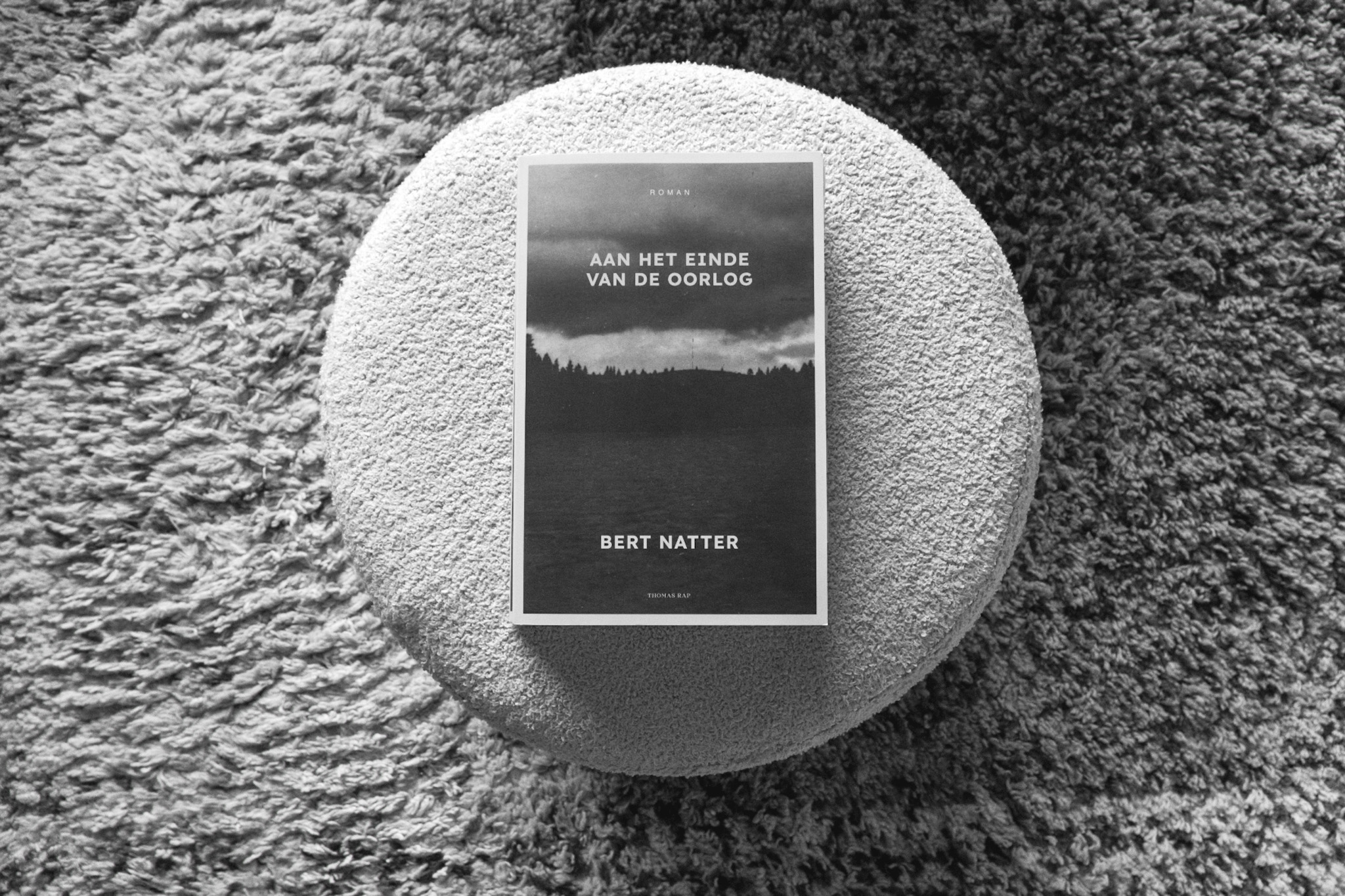
There will be no novel this year that surpasses Aan het einde van de oorlog by Bert Natter. In 630 pages you live through the final day of the Second World War in and around a concentration camp. All manner of things happen that turn your stomach, yet you cannot stop reading. That’s just how it goes — with this kind of horror you cannot look away.
From the back cover:
The eleven-year-old Ernst, son of SS-Oberstormführer Karl Zehlendorf, goes missing near a concentration camp. His brother Reinhart claims to have left him at the bank of the treacherously deep lake where they were fishing. Surely he didn’t fall into the water? While the Allied armies can already be heard in the distance and everyone in the camp senses the end of the war approaching, Karl sets out to find his son.
Now you know at least something about the thread running through the book, but so much more happens. In total you follow 31 characters, in mini-chapters that constantly alternate. That sounds overwhelming, but it is done so ingeniously that you never lose the thread. And because Natter keeps planting small cliffhangers, you cannot stop.
The book is as intense as you might expect from a story set in and around a concentration camp. “The entire book is permeated with the smell of burning people,” Natter says in the podcast Nooit Meer Slapen. And everyone around them suppresses it, as if nothing is happening. The chimney that keeps belching dirty smoke? Must be a bakery. The book is tonally similar to the film The Zone of Interest. “It’s actually quite nice here if you’re not forced to live here,” thinks Karl’s wife in her villa near the camp.
Natter constantly places extreme opposites side by side. Karl is responsible for the extermination of thousands of people, yet time and again he turns out to have more in common with the Jewish people in the camp than with his Nazi colleagues. During his search for Ernst, Karl stumbles from one distraction to the next, anything to avoid having to draw conclusions. It is almost like hiding inside the concentration camp.
Aan het einde van de oorlog is crushing, by turns shocking and intense. But Natter describes it in a tragicomic way. He lays it on thick — the Nazis are almost theatrically evil, their deeds grotesque. Natter jabs with pin-pricks and runs recurring gags. Near the end a Nazi gets his just deserts and a final twist that had me laughing out loud. That’s how Natter keeps bringing you back down to earth. Am I laughing at a book about a concentration camp? Am I savouring juicy cliffhangers? An extraordinary book.
II.
After The Remarkable Life of Ibelin, there is another feel-good documentary about an online community: Grand Theft Hamlet. Two theatre actors sitting at home unemployed during the covid pandemic came up with the brilliant idea of staging Shakespeare in GTA Online. It turns out to be no simple thing to organise — as one of them says in the film, if you were to draw a Venn diagram of Shakespeare lovers and GTA players, there would be very little overlap.
The auditions for finding fellow players for Hamlet go badly. Every time the directors approach someone, the encounter descends into a virtual shootout. Massive explosions, police arriving. Hilarious, of course. The chaotic game world of GTA, where anything goes, is absolutely not suited to such an artistic project. Which is precisely why the idea is so good.
Slowly but surely, people do trickle in who want to be part of this story. A lovely moment is when a passer-by named Parteb, in a green alien costume, stumbles upon the auditions. One of the actors asks if he would like to recite something from Shakespeare. Instead, the man — who fears his English is not good enough due to his Finnish-Tunisian background and who knows nothing of Shakespeare — recites a passage from the Quran in Arabic. Those present are so warm and encouraging that Parteb ends up hanging around for the rest of the project.
These kinds of random encounters show exactly the power of online games and the communities that spring up within them. These are the moments that make Grand Theft Hamlet worthwhile. The moments where the makers are clearly working from a script to force some kind of dramatic arc are less successful.
III.
Craig Mod writes about rubbish: “Funny how that works with Snickers. Once you’ve eaten the bar, the wrapper transforms from useful to litter.” In Japan there are no rubbish bins on the street, which means you take your own waste with you and throw it away at home. That makes you somewhat more aware of the purchases you churn through in this consumer society.
And it makes people responsible for their own rubbish. That’s how it should be, says Mod, who goes on to muse about how convenience leads to stupidity.
The modern condition consists of a constant self-infantilization, of any number of “non-adulting” activities. The main being, of course, plugging into a dopamine casino right before going to sleep and right upon waking up. At least a morning cigarette habit in 1976 gave one time to look at the world in front of one’s eyes (and a gentle nicotine buzz). Other non-adulting activities include relinquishment of general attention, concentration, and critical thinking capabilities. The desire for deus ex machina style political intercession that belies the complexities of real-world systems. Easy answers, easy solutions to problems of unfathomable scale. Scientific retardation because it “feels” good. Deliverance — deliverance! — now, with as little effort as possible.
PS.
Vox explains how digitally de-ageing actors in films has improved in recent years. The technique is incredibly difficult to get right. “When you look at someone and something is off about their face, we immediately think: that person is ill,” explains Kevin Baillie, responsible for the visual effects in the film Here, in which actors including Tom Hanks and Robin Wright have been made both younger and older using computers.
From Hay Kranen’s newsletter: Why art is necessary. “A classic example is trying to explain to someone what ‘the colour red’ is. You can only do that by pointing to objects that are red. The same goes for scents or tastes. Think about how wine experts describe the flavour of wine: ‘intense bouquet of cigar and clove with secondary notes of leather and glazed red fruit and well-structured tannins.’”
A dose of childhood nostalgia: Samurai Pizza Cats. An anime series about three cyborg cats who work in a pizza restaurant by day and fight evil to protect their city by night. The series is full of parodying jokes and pop culture references. Although no new episodes have been made for decades, a game is now being released. The trailer breathes nostalgia (the subtitle is, fittingly, Blast from the Past).
The Dutch research institute Waag Futurelab, focused on technology, art and society, is turning 30. To mark the occasion you can download the book Het internet is stuk (The Internet is Broken) by director Marleen Stikker for free. Highly recommended: Stikker explains in precise detail how the promising internet of the 1990s was hijacked by Big Tech. It is not a complete downer — the author also explains how we can reclaim the internet.
I often read the pieces by writer Henk van Straten in my inbox. I wanted to share a link, but I have no idea where you can subscribe — if he is even actively recruiting readers anywhere. As a closing note for this week I’ll just paste two paragraphs from his latest piece Killer drones & een elektrisch kacheltje (Killer Drones & a Small Electric Heater) in the wild:
Trump says: ‘Ukraine should not have attacked Russia, should never have started the war.’ You just never get used to it, the shamelessness. You think you do, and then they pile on another layer. With books like 1984 I always thought: by exaggerating like this you expose a subtler reality. But it can actually happen just like this, without exaggeration. You can simply say: the sky is green, and then fire/prosecute/etc. the people who keep insisting that the sky is blue. At a certain point you’re not even allowed to think that the sky is blue, and to enforce that law you need, as in 1984, thought police.
It’s a shame that every comparison with 1984 already feels toothless. The umpteenth comparison with that book. Sure, bring out 1984 again! That’s the difficulty: there are no comparisons left to come up with — not from books, not from historical events — that still make an impression. We are past that point. It’s like a dream in which you open your mouth to say something but can’t make a sound. Your panic has nowhere to go, reaches no one.
Thanks for reading this newsletter. Feel free to share!