
112. How I do it
I.
Five minutes after reading about the initiative Mei Social Vrij (Social Media-Free May), I was already announcing that I’d be taking part in the experiment. A whole month without social media. What I noticed: without trying to convince anyone, friends immediately said they’d join in too.
I’m going all in. I’ve deleted the apps for Instagram, Bluesky, Threads and LinkedIn from my phone. X and Facebook weren’t on there anymore anyway. On my laptop I’ve installed SelfControl, an app that you do have to activate every day, but which then truly locks you out of the web versions of social media. Even if you got down on your bare knees and begged. I’ve also blocked YouTube on my laptop — watching videos is only allowed on the TV.
It’s not about social media itself. I genuinely enjoy sharing a photo on Instagram and a link on Bluesky. And they are also black holes that sometimes drag me under.
It probably helps that I have two weeks of holiday. One of those weeks I’m in Scotland to walk part of the West Highland Way. Which means I’ll be in the middle of nowhere, practically offline. The question is: how do I survive those dead moments, like waiting at the airport? That’ll work out fine too.
II.
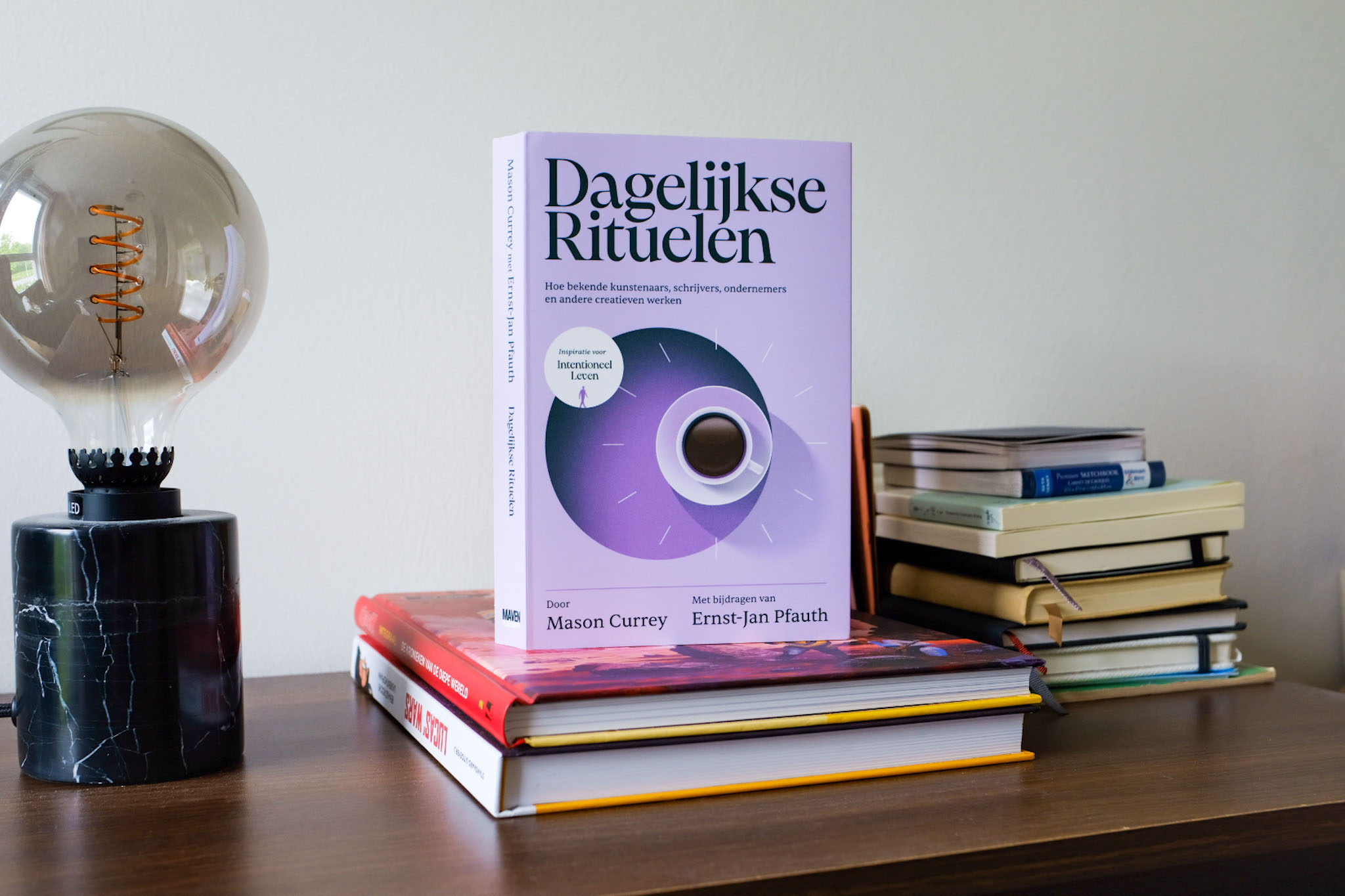
I’m reading Daily Rituals by American author Mason Currey. The book is packed with mini-biographies of artists and writers, focusing on how they structure their creative working day. A new edition of Daily Rituals recently appeared with additions by Ernst-Jan Pfauth1, who researched the habits of twenty well-known Dutch figures.
Like Currey and Pfauth, I am overly fascinated by how others do it. What notebooks does someone use? What pens do they write with? What inspires the artist? I enjoy reading blogs where people write about this, like the People and Blogs series by Manuel Moreale, or the website Uses This. This book describes in short pieces how Haruki Murakami does it, for instance. And how Jane Austen, F. Scott Fitzgerald and Graham Greene did it.
The best way is to read a few chapters at a time, but if you read greedily you do start to notice certain patterns. Making and drinking coffee features a lot in the routines of our creative types, for example. And walking. For many, the practice of the arts turns out to be a matter of short sprints and suffering in between. Yet they all found a way to get words on paper or paint on canvas.
Sometimes the daily rituals aren’t all that remarkable; other times you wish the biography were a little longer to really get to the core. But depth is perhaps not the most important thing about this book. It does inspire.
Pfauth’s additions are more than welcome. How the classic writers did it differs quite a lot from how we do it today. Modern society moves considerably faster, we are heavily and constantly connected and distraction is always lurking. You can, like Arie Boomsma, go out and chop wood every day. But something more grounded and realistic is how Aaf Brandt Corstius works. She organises as many deadlines for herself as possible. Her advice to young writers is accordingly: “Make sure you end up somewhere that gives you lots of deadlines and the ability to produce a lot of output. Because you can’t sit around waiting for divine inspiration and write one poem a year. You can, but I don’t think it makes a career.”
III.
How do I do it? I think I do have some habits and rituals that get me to work. To start with, I don’t believe in snoozing. There are people who enjoy the sound of their alarm so much that they want to hear it three or four times. Mine goes off once and then I get up.
I start work at eight o’clock every day. That lets me avoid the rush hour on public transport and, since most people don’t start until after nine, I give myself that hour as a gift — time to read quietly and add to my to-do list. I write my tasks with a Lamy Safari fountain pen in an MD Notebook by Midori. I have a simple date stamp by Trodat with which I stamp the current date above my task list every day. I don’t like digital to-do lists, and I always carry a separate notebook in my pocket.
Written notes feel like they disappear less easily than notes in the digital swamp. Though I do keep a list in Notion of links I might want to use for my blog later. I delete that list every week once the blog goes live.
Every morning starts with a cup of tea. After that I drink two more cups of coffee in the morning and sometimes another coffee in the afternoon. Especially when working from home, I find making coffee a pleasant moment of calm between bouts of writing. When I work, I like to divide my day into two halves. I prefer to do interviews in the morning, so I can focus on writing in the afternoon. In practice it’s messier than that, so the ideal routine doesn’t always work out.
I stop at four, though it can run later sometimes. Then I read a book until dinner, take a walk, go for a run or do some gaming. In the evenings I enjoy watching a film, and if the TV is occupied I usually read a book. There is not a day that goes by without me writing.
PS.
The BBC is offering an online writing course with Agatha Christie as the teacher. A deepfake, naturally. I still find it somewhat uncomfortable: bringing deceased people back to life when they were never able to give their consent during their lifetime.
This is such a ridiculous project that I have to share it. An animator (Andymation on YouTube) is planning to convert The Fellowship of the Ring entirely into flipbook animations. He needs 1,600 people to make it happen. It would be wonderful if he pulls it off. Another brilliant project that wouldn’t work without an internet community.
Is there an actor with a better face than Willem Dafoe? This is a delightful short film by Modern Weekly with a gorgeous final shot.
You cannot get any closer to Vermeer’s Girl with a Pearl Earring than with this scan by Hirox. Captured in 108 billion pixels, so you can zoom in incredibly far. 3D scans of various parts of the painting have also been made, in which the dabs of paint and the cracks come to life even more vividly.
On NU.nl I’ve recently started writing weekly blogs too. This week it’s about filing an objection with Meta so that your personal data isn’t used in their AI training models. And how, one way or another, you end up in those models anyway.
Right, this cover of Creep.
I’m on holiday for a few weeks now, but I’m still writing. Next week there will be a regular blog (perhaps slightly shorter) and I’ve decided that the week after that I’ll write a travel diary from the West Highland Way, as I did when I was in Japan. With photos!
Thanks for reading Deze week! Subscribe for free to receive new posts and support my work.
[1](#footnote-anchor-1)Ernst-Jan emailed me asking if he could send me a copy of the book. He expected nothing in return and we made no arrangements about a publication. Though the content of *Daily Rituals* fit so neatly into my wheelhouse that I was happy to write about it!