
151. An evening with Tilda and Wes
I.
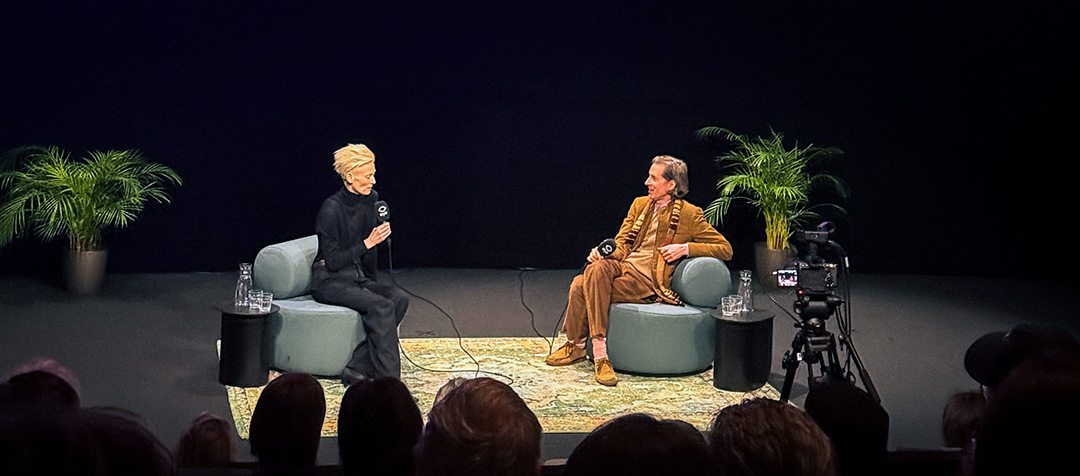
It is wonderful to see how engaged Tilda Swinton is with the retrospective and the exhibition around her work at the financially troubled film museum EYE. She seems to be there more often than not. One day she is spotted in the restaurant; the next she is introducing her films. This week she invited filmmaker friends to talk to packed audiences about their work. So EYE welcomed high-profile visitors on three consecutive evenings: Joanna Hogg, Luca Guadagnino and Wes Anderson.
I was one of the lucky attendees at the evening with Anderson — for years one of my favorite directors. Using four clips from Anderson’s films in which Swinton has a role, they were to guide the conversation. So they wouldn’t wander too far. Which of course they did anyway. So much so that Anderson sometimes seemed to forget the audience was there. Unconsciously, as he talked, he would gradually turn his chair further toward Swinton until he was almost sitting with his back to the hall. Then he would quickly turn back around. “Sorry, is this actually interesting for you?” he would ask. (Yes!)
The audience was listening to two friends reminiscing. It produced remarkably entertaining anecdotes and insights. Anderson, for instance, always puts his cast in a hotel together to create a sense of family. No one has their own trailer. Not even if you are Benicio Del Toro or Tom Hanks. The cast eats together and every morning Anderson drives them to the set in golf carts; the set is always nearby.
“For Asteroid City I was looking for a flat stretch of land to build the set on,” said Anderson. “But it had to be close to a four-star hotel. Not a five-star hotel. Too expensive. But… not a three-star hotel either.”
Swinton and Anderson also recalled stories about actors. Bruce Willis, Gene Hackman, Bill Murray. But the best anecdotes involved Harvey Keitel. “During Moonrise Kingdom I had asked Edward Norton to carry Harvey Keitel on his back,” says Anderson. “I had asked for a kind of Keitel sculpture that he could carry, one that would look very convincing from certain angles.”
“We kept calling it a Harvey Keitel backpack. But our props master — whom I love and have worked with for a very long time — was simply… disobedient. He didn’t want to make that Harvey Keitel backpack. He kept bringing things that made me think: you call that a Harvey Keitel backpack? He just wouldn’t do it. And in the end he really refused to continue. So we never had a truly good Harvey Keitel backpack. Edward had to carry the real Harvey Keitel. And he is a heavy man. I can say many wonderful things about him: he is very solid. Compact. There is a lot of muscle mass in there.”
And so the conversation went on. Everything was filmed and will eventually appear on EYE’s website.
II.
Frank Miller is a comic-book legend. He made The Dark Knight Returns, in which Batman is darker and more cynical than ever. And he wrote some of the most defining Batman stories with Batman: Year One. Miller breathed new life into Daredevil in the 1980s and made Sin City and 300, both of which were later adapted into highly stylized films.
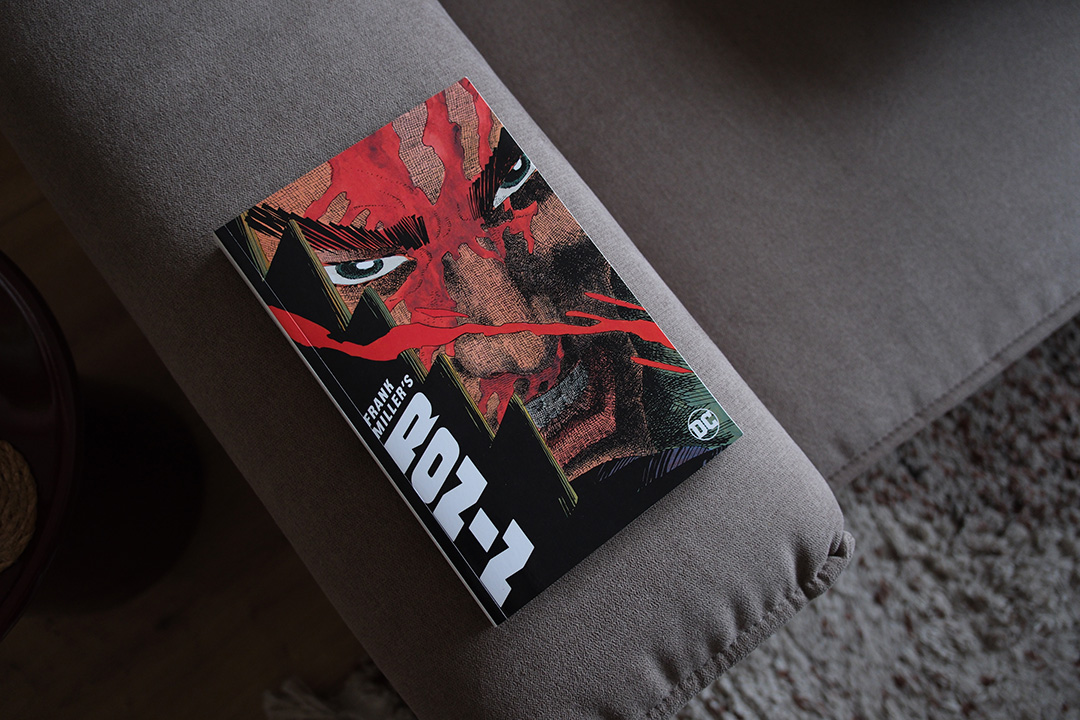
Some time ago I bought Miller’s comic collection Ronin, a six-part story originally published in the early 1980s. The story follows a samurai from feudal Japan who is killed and then reincarnated in a dystopian future New York. His arch-enemy, the demonic Agat, has appeared there too.
If you’re already blinking in confusion, brace yourself. This story is pure, hard-boiled science fiction. New York has been taken over by a mysterious biotechnology that keeps growing. “It began with the invention of computer plastics that mimic living tissue in many respects,” someone in the book explains. The technology begins to reproduce and develop autonomously. “So rapidly and powerfully that we now observe more than we experiment. There is no longer any doubt that we inhabit a living organism — a vital, flourishing, mutating being. Its brain is called Virgo, our computer, which is not only conscious but also creative. Frankly, it is difficult for us to keep up with her ingenuity.”
These kinds of concepts are a bit less sci-fi than they were forty years ago, but the book is so full of them that it quickly becomes dizzying. Even so, Ronin is at its core simply a revenge story, beautifully drawn by Miller, who uses scratchy ink strokes to give his panels enormous momentum¹. Both Teenage Mutant Ninja Turtles and Samurai Jack are partly based on this comic.
PS.
Bruce Springsteen surprises with a pointed protest song: The Streets of Minneapolis. It’s wonderful when an artist of this stature uses their voice in the fight against oppression. “Oh, our Minneapolis, I hear your voice / Singing through the bloody mist / We’ll take our stand for this land / And the stranger in our midst / Here in our home, they killed and roamed / In the winter of ‘26 / We’ll remember the names of those who died / On the streets of Minneapolis.”
Amelisweerd appears to be saved after sixteen years. The Dutch parliament has voted against widening the A27 near the Utrecht estate. The lives of hundreds of trees have been saved.
“We plan our lives like we’re editing a movie trailer.” That is how this essay by Joan Westenberg begins, in which she essentially argues for embracing the daily grind rather than constantly trying to escape it. “The goal isn’t a life with more peak moments. I think that’s a false and ever-elusive pursuit. The goal is a life whose default setting doesn’t require escape. Your future is made of boring days done on purpose, and a life you need a vacation from is a design problem rather than a motivation problem.”
What Jason Velazquez writes: “On New Year’s, I made a couple of silly tech predictions for 2026 (because it’s fun guessing what our tech overlords will do to become a literal Prometheus). The first prediction is innocuous enough. I think personal website URLs will become a status symbol on social media bios for mainstream content creators. Linktrees are out. Funky blogs with GIFs and neon typography are in. God, how I hope this one happens. Not even for nostalgia. In the hyper-scaled, for-profit web, personal websites are an act of defiance. It’s subversive. It’s punk.”
Just a delightful online tool. Upload a photo and see its color palette.
Harry Styles is playing the ArenA ten times this year. I’ll sit this one out. This is a good video, though.
You read blog №151, written in the week of 26 January to 1 February 2026. Subscribe to my newsletter and you’ll receive it every Sunday free in your mailbox.