
19. Barbenheimer

I.
Barbie is a hysterical fever dream of a film and one of the biggest blockbusters of this year. Greta Gerwig had the insight that Barbie’s plastic-perfect world forms an ideal mirror for our reality. So it is not just a commercial for Barbie dolls, but a lavishly overstated manifesto for feminism, in which today’s male-dominated society gets thoroughly dissected.
The message in the film is as subtle as a hammer to the face, but subtlety was never the point of Barbie anyway. The quiet moments and preachy speeches are what actually slow things down a bit. And there are plenty of plot holes to poke at, but why bother? Surrender to Barbie’s bizarre dream world and enjoy.
Just as I enjoyed the references to film classics like The Wizard of Oz, The Truman Show and 2001: A Space Odyssey. But my favourite was the one to The Matrix. Instead of a red and a blue pill, Barbie chooses between a stiletto heel and a flat sandal to either stay in a dream world or discover the truth.
I’ve never seen the cinema so packed. After our full screening the next queue was already stretching outside. Plastic sells!
II.
Christopher Nolan made a film about American physicist J. Robert Oppenheimer: the father of the atomic bomb. It runs three hours but moves at such a pace that you’d do well to keep your concentration. Oppenheimer’s story is told from all kinds of angles (and time periods) and when it’s over you can still argue at length about who the man really was.
The film opens with a description of Prometheus, the Greek Titan who stole fire from the gods and gave it to humanity. He spent the rest of his life paying for it, as Zeus chained him to a rock. The atomic bomb became Oppenheimer’s legacy and he had to live with the consequences.
In Oppenheimer we follow the life of the physicist who ultimately manages to build a bomb that could destroy the world. Or that prevents a Third World War. The film builds step by step toward the first successful test of the bomb and when it happens you feel the weight of the moment. It is then jubilantly celebrated.
That is the only time we see the bomb drop. Otherwise you’re mostly watching dialogue. And that is precisely why that one moment works so well. But thankfully the film doesn’t stop there. That’s when the real nightmare begins.
III.
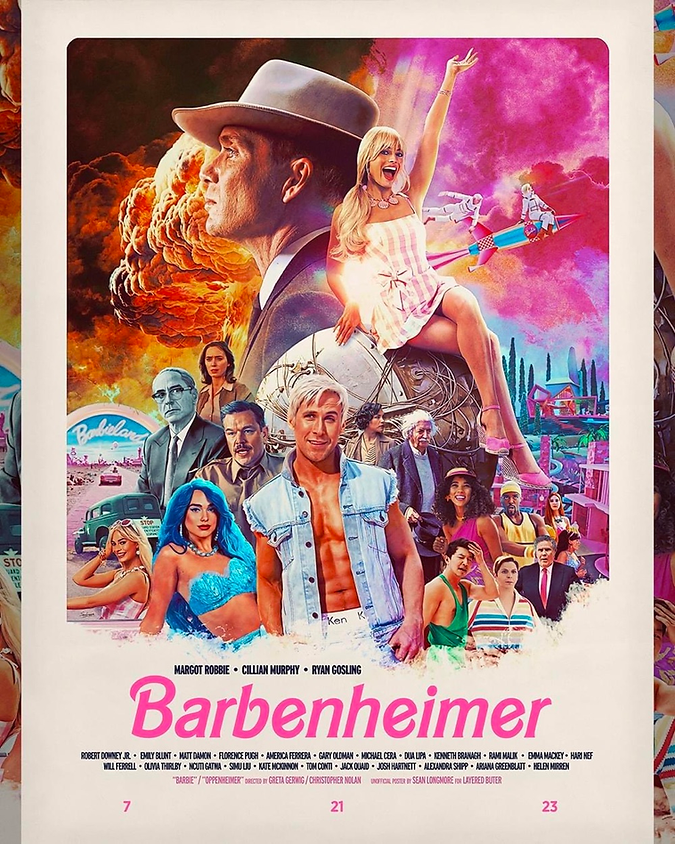
It was an electrifying film weekend with Barbie and Oppenheimer, probably the film event of the year. The contrast between the two films could not be greater, and that is probably what caught the internet’s attention. The word Barbenheimer quickly emerged and the films were woven together in fan trailers and posters.
Funnily enough, with a bit of goodwill you can also connect the films thematically. Both protagonists strive for a perfect world but discover that such a thing does not exist. With all that that entails.
“Do you ever think about death?”, Barbie asks in a world where nobody ever thinks about death. That question seems directly addressed to the men in Oppenheimer who work so passionately on bombs that cost hundreds of thousands of Japanese people their lives.
Want a clearer example of what happens when men are in power? Sooner or later they build a bomb that can destroy the world.
IV.
The 1984 film Electric Dreams is not very good and not particularly well known either. But it is fascinating because of the computer that plays a central role. The machine was pure science fiction at the time, but nowadays it is no worse than Siri and ChatGPT.
In the film the computer goes a step further, as it develops a consciousness. It learns what it feels like to be in love and to be jealous. These qualities come between the budding romance between Miles and his new neighbour Madeline.
Miles has had the computer compose a love song for Madeline, but keeps it secret for a long time. Eventually he plucks up the courage. “What if there was a machine that could make art?”, he begins. “Or that could write poems and make music?”
“What’s wrong with artists?”, she replies.
Nearly forty years later, this question forms one of the most important discussions we are having about artificial intelligence. Books written by AI took over the Amazon charts, we have been flooded with AI music over the past months and Hollywood actors are on strike because they fear being replaced by AI.
And then that computer from the film, who keeps pressing more and more insistently for Miles’s attention. Upon which he shouts: “You’re controlling my whole life!” It might as well be a smartphone.
In Electric Dreams, Madeline plays her cello in an orchestra. She is inconsolable when her instrument breaks, because she has had it since she was a child and that alone makes it irreplaceable. Miles tries to cheer her up. “That cello is so special because you put a piece of yourself into it; the instrument itself is just a piece of wood.” That of course forms a nice analogy with the computer. And that’s how we also look at artificial intelligence. Without us it does (still) nothing. Let’s keep it that way.
PS.
Finfluencers promise you gold mountains on TikTok and YouTube if you invest your money cleverly (and quickly). In all kinds of cryptocurrencies you’ve never heard of, for example. “Getting rich quick is not possible with careful investing”, says the director of the Dutch investor association VEB in this Pointer video. “But getting poor quickly with this approach is entirely possible.”
Blur is back after eight years with a new album. The Ballad of Darren. My first impression is good!
I’m reading Emma Cline’s second novel The Guest. I’m a big fan of her first, The Girls, about a Charles Manson-like cult. The new book is about a young woman drifting through a wealthy corner of America.
If you could bring back a deceased loved one with artificial intelligence, would you? The Guardian has an interesting article about grieving in the age of AI.
Here’s a beautiful ad from a French telecom provider about the national football team. With a twist at the end.
A casual suggestion if you have 1,699 dollars burning a hole in your pocket: this working Grimlock Transformer from Robosen and Hasbro.
Subscribe to this newsletter and receive it every Sunday for free in your mailbox!