
24. I visited the Holocaust Museum in Fortnite
I.
Fortnite is a bizarre place, where people dressed as Spider-Man, a wizard or Goku from Dragonball Z shoot at each other with weapons, do dances and spray graffiti. Alongside the well-known battle royale mode there are player-built escape rooms, racing games and advertising worlds for all kinds of brands. And somewhere in that madness a Holocaust museum has recently appeared. I visited this virtual exhibition, which is called Voices of the Forgotten.
And so there I stood, dressed as Optimus Prime, reading about Kristallnacht.
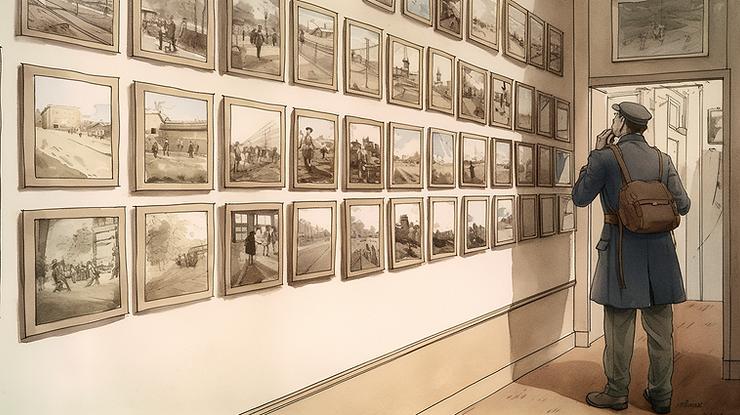
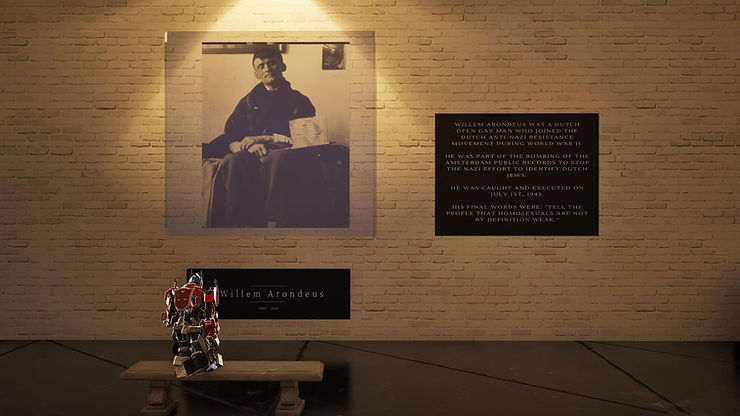
Inside, all kinds of black-and-white photographs hang on the walls. They are portraits of heroes who saved Jewish lives during the Second World War and of Jewish resistance fighters. For more information you can read short texts next to the works that tell the history of the photographed individuals.
It is not very interactive. Where Fortnite is normally a carnival of sounds, images and constant stimulation, the museum is an oasis of calm. To keep the virtual exhibition respectful, you cannot dance and cannot spray graffiti.
That is quite a contrast with the regular Fortnite game. Most (young) players will drop out quickly, I fear, because you have to put in time and attention yourself. And it’s not easy to get to Voices of the Forgotten in the first place, as you have to manually type in a code. During my visit I was the only one there.
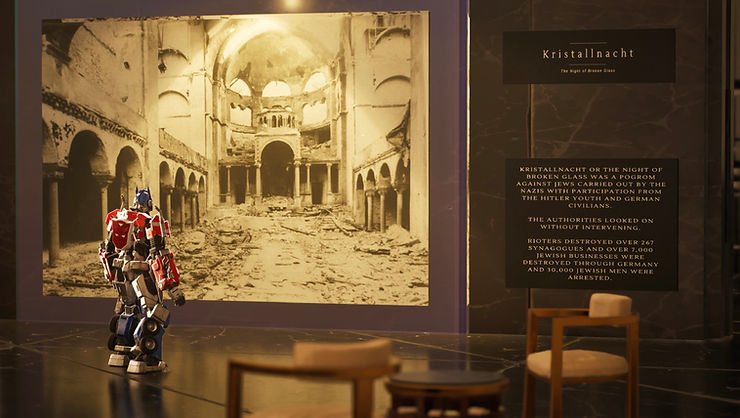
British game developer Luc Bernard wants to use his Fortnite level to teach people about World War II events in an accessible way. “A majority of Americans have never visited the Holocaust Museum in Washington”, he tells Artnet. “That is not their fault. Museums are inaccessible for many people because they are located in big cities. Museums are great, but we also need to think about people who can’t get there.”
The stories were selected by Bernard himself, he emailed me when I asked. You can read, among others, the story of Willem Arondéus, a Dutch artist and resistance fighter who was also openly homosexual. The museum, incidentally, pays a great deal of attention to heroes with an LGBTQ+ background. “I gave them a platform because many others have erased their stories”, says Bernard.
Voices of the Forgotten is not perfect — a lot of general context about the Holocaust is missing, for example — but it is a sympathetic attempt to teach the Fortnite player something about an important piece of history. I had hoped the exhibition would be a bit more interactive. After all, it is still a game. But Bernard continues to work on the virtual museum. An audio tour is coming soon, so people won’t have to read the panels. “And a new exhibition will be added every month.”
You can visit the museum for free via Fortnite code 1511-8598-6202.
II.
In Twin Peaks: Into the Night you play through the beginning of the first season of Twin Peaks. In this game you are special agent Dale Cooper, who arrives in the small town of Twin Peaks to investigate the murder of schoolgirl Laura Palmer. You visit familiar locations, talk with the mysterious residents and solve several puzzles.
The game is both a tribute to the TV series of the same name (of which I am a big fan) and to games from the nineties. Into the Night looks like a PlayStation 1 title and plays like one too. The tank controls (you move as in the original Resident Evil) take a little getting used to, but every Twin Peaks fan will play through the demo with a smile. You encounter characters like the Log Lady and Sheriff Truman, and find funny references to the series everywhere.
The blocky style suits the era in which the first season of Twin Peaks aired. The aspect ratio is also an old-fashioned 4 by 3. The demo itself is far from perfect — the voices sound quite poor and the puzzles are not always logical. But as pure fan service, it is wonderful to walk through a small part of Twin Peaks yourself and to see what a PS1 translation of the series might have looked like.
It is free to download for PC and you can get through it in about an hour.
III.
French developers Lucas Guibert and Jean Manzoni made this unofficial game demo of Twin Peaks: Into the Night. Under the name Blue Rose Team (BR), they were kind enough to answer a few questions about their project by email. (Yes, this journalist is on holiday, but I couldn’t help myself.)
I didn’t expect the TV series to work as a game, but you’ve pulled it off. Why did you want to make this?
BR: “First of all because we are fans and we enjoy making games. On top of that, it used to be very common for films and series to get a video game adaptation. We asked ourselves: what might it have looked like if there had been a Twin Peaks game?
We also wanted to stay true to the series and largely follow the story. But a game needs more freedom. We thought about what happens off-screen and were able to invent new things, such as fleshing out locations and characters.
You also play the game as Dale Cooper, while you experience the series from multiple perspectives. You also have to make choices to follow the story, for example by adapting scenes, dropping them, or rearranging them. That creative process is very exciting for us.”
Are you working on a full game? And how much of Twin Peaks will we get to see?
BR: “We are working on that, but we are going step by step. We would have to use the Twin Peaks licence, for example, and it remains to be seen whether that is allowed. But it would be wonderful to release the entire first season as a game. It is hard to say when that would happen.”
I think the PS1 aesthetic fits the atmosphere of the TV series very well. Was that your main reason for choosing this style?
BR: “Absolutely! The series is from the nineties and we felt it was therefore fitting to choose a medium from that era. It also suits the strange atmosphere of the series.
But from a technical standpoint, we also couldn’t build a modern game with the best 3D graphics. Not that we want to suggest that replicating old-school 3D art is easy — quite the contrary!”
Have you received any reactions from people involved with the series?
BR: “A number of actors from the third season have shared the project on social media and sent us encouraging messages. That is of course fantastic for us. In our wildest dreams we would hear what Mark Frost, David Lynch and Kyle MacLachlan think of it, but we have not yet heard from them. It’s not easy for two unknown tinkerers to get in touch with such famous people.
We hope our project would give them pleasure. Of course we also hope for their approval. But releasing the demo has shown that fans are certainly eager for it. We think we can really make something cool out of this.”
PS.
Remember that YouTuber who went looking for the story behind the internet meme Michaelsoft Binbows? I wrote about it in my sixteenth weekly blog. That same guy, Nick Robinson, has taken a plane and actually travelled to the location where that banner once hung. A surprisingly entertaining travel vlog to a remote corner of Japan.
No idea what kind of game this is going to be, but the trailer looks great. Thank Goodness You’re Here! is the new game from the creators of Untitled Goose Game. It comes out next year.
Tim Knol is back with a new album: Long Live Your Friends. Slightly less tightly produced than the excellent Lightyears Better that came out last year, but that leaves more room for experimentation and spontaneity. I have a soft spot for Knol’s warmhearted songs.
And Nick Cave has another album too. Without new songs. Australian Carnage contains live recordings from his Carnage tour that he undertook together with right-hand man Warren Ellis. Two hours of bliss. As if you were there, at the Sydney Opera House.
Look at your own body and you’ll find traces of evolution everywhere. All sorts of parts of our body that we no longer need but that our animal ancestors couldn’t do without. A clear explainer from Vox.
Filmmaker Nikita Diakur really wants to do a backflip but doesn’t quite dare. So he created a virtual version of himself that he trained using machine learning. His avatar would eventually do what he couldn’t manage in real life. That too became a process of practice, practice, practice (but without the risk of injury). Hilarious video on The New York Times.
Thank you for reading! Subscribe to this newsletter and receive it every Sunday for free in your mailbox.