
53. Masters at work
I.
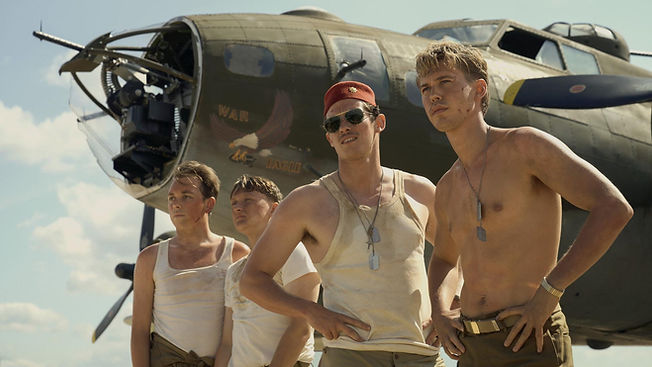
All nine episodes of Masters of the Air are available on Apple TV+. This is the third instalment in the Second World War trilogy produced by Steven Spielberg and Tom Hanks, following Band of Brothers and The Pacific.
We follow the crew of a group of American bombers, flying back and forth from a British base to Nazi Germany to bomb the place to smithereens. The aerial combat in the series is breathtaking, claustrophobic and spectacular. It is nothing short of a miracle that those cool-headed men kept climbing back into their cockpits time and again, whilst watching one plane after another being shot down and constantly losing friends.
In this drama, we mainly follow the pilots and best friends Buck Cleven (Austin Butler) and Bucky Egan (Callum Turner). With their sparkling chemistry, they are the stars of the series, the great heroes. Butler plays his role almost too cool and charismatic, with the witty troublemaker Turner as the perfect foil. Around them, all sorts of personal stories come together, featuring characters based on real people. The series is narrated by Major Harry Crosby (Anthony Boyle), whom we first meet as a nervous route planner, but who develops into an important and complex figure over the course of the series.
Pilot Robert Rosenthal (a fine performance by Nate Mann) is one of the characters who remains somewhat one-dimensional, but who finds himself caught up in a few chilling scenes in the final episode. A war fought in the air feels like a detached struggle, because you don’t usually look the enemy in the eye and you get little sense of what’s happening on the ground. Imagine the shock that awaits you when you suddenly do get to see that. At the end of the series, you suddenly feel the impact of everything that remained abstract in previous episodes.
Don’t get me wrong. Much of the criticism Masters of the Air receives online is justified. The series is too slick, too clean, too produced. The budget is obvious. In every scene, the sunlight is golden and the CGI makes the drama feel distant. When Bucky walks through a devastated street, it’s clearly a set with tightly directed chaos. And yet it works, with that beautiful soundtrack. So you find yourself swallowing hard a few times during the final episode.
---II.
It’s been almost a week, but just a quick word on the Oscars. Hoyte van Hoytema won his first golden statuette for his cinematography on Oppenheimer.
Van Hoytema is the eleventh Dutch person to win an Academy Award. The first was for Bert Haanstra’s documentary Glas, a short film about glassblowing. The film adaptation of De Aanslag by director Fons Rademakers also won an Oscar. The same applies to Karakter by Mike van Diem and the short film Father and Daughter by Michaël Dudok de Wit.
In 2013, ‘we’ won one for the last time. At least, for the contribution made by Erik-Jan de Boer and his team to the visual effects of Life of Pi.
I’m now telling everyone that Hoyte van Hoytema grew up in Dinteloord, Brabant. Just like me. Incidentally, he wasn’t known there until recently, but he is now. “I really love the attention from my little homeland, which has now started to claim me as its own,” Van Hoytema tells De Volkskrant (in a somewhat patronising tone).
In the same interview, he says he would like to “someday do something about the place and the time” where he grew up. The Dinteloord of the 1980s. “In Oppenheimer, I also recognised something of my own fear of the arms race and the Cold War of the 1980s,” he says. Dinteloord isn’t all that far from a Belgian nuclear power station, just across the border near Woensdrecht.
Oppenheimer in the polder, through the eyes of a child who later became an Oscar winner. Bring it on.
III.
Tim Berners-Lee, the inventor of the World Wide Web, is known to have been less than pleased lately with how his creation has matured. This week marked the web’s 35th anniversary and he spoke out again. The idea behind the web was once to enable collaboration, bring people together and stimulate creativity, he writes. In the early years, that went well.
“But over the past ten years, the web has played a part in eroding those values,” says Berners-Lee. “Five years ago, I already highlighted problems caused by the web being dominated by the self-interest of various companies. They undermined the values of the web and led to breakdown and damage. Now, on the web’s 35th anniversary, the rapid progress of AI has only amplified these concerns. The problems on the web do not stand alone, but are intertwined with emerging technologies.”
Berners-Lee therefore praises the pioneers who are devising new ways to put the individual first again, rather than the companies that control the web and are after our attention and data. Because it is not all doom and gloom. “Bluesky and Mastodon do not feed off our interaction, but they do create a sense of community,” he writes. “Github provides the tools for online collaboration, and podcasts contribute to our collective knowledge.”
Subscribe to this newsletter! You’ll receive it in your inbox every Sunday, free of charge.
---PS.
Happy Book Week! Perhaps this is the moment to start reading Lessons by Ian McEwan. It’s about the life of a boy growing up just after the Second World War who, during his teenage years, begins a strange affair with his older piano teacher, something that haunts him for the rest of his life.
I’m recommending this book so you can join in with the mini-book club that Lars and I have started. For six weeks, we’ll be reading two chapters each time and sharing our thoughts in a podcast. In episode two below, you can hear what we thought of chapters 3 and 4.
---It’s been a brilliant week for music. Nick Cave and the Bad Seeds have announced a tour that includes a stop in Amsterdam. So if you want to know where I’ll be on 26 September: I’ll be right at the front of the Ziggo Dome. Last week saw the release of the first single from the album Wild God, which is due out later this year. Once again, it’s fantastic, innovative and more accessible than Cave’s other recent work.
---I thoroughly enjoyed The Smile at AFAS Live. You have to grab every chance to see Thom Yorke and Jonny Greenwood with both hands and never let go. Although the second album has only just been released, there were already three brand-new songs on the setlist. A few odd ones out, some fleshed-out demos, a treat for the fans. In a few years’ time, you’ll hear them again and realise that back then, at AFAS, you were listening to rough diamonds.
---As well as my Balatro-addiction, I’m also starting to develop a healthy obsession with puzzles. Every day I visit the puzzles section of The New York Times. I have a quick look at the mini crossword, the sometimes excruciatingly difficult word association game Connections, a round of Wordle and, now and then, the word game Spelling Bee. Oh, and now I’m also playing Denksport’s daily crossword.
The Atlantic has an entertaining article about the NYT puzzles.
> “After all, a feeling of frustration at one day’s crackbrained answers is intrinsic to the newspaper-puzzle genre. Perversely, getting mad about the puzzle can be part of the fun; it offers a common, light-hearted gripe in the family text chat. Tomorrow offers another shot at delight.” > > > > --- > >
During a recent interview on the subject of phone addiction (a term that doesn’t actually exist scientifically), I suddenly realised something. The current generation of young parents is the first to have grown up with a smartphone themselves. Scrolling through doomscrolling on the sofa is nothing new to them. But if you find yourself staring at a screen all day out of habit, how are you going to keep your young child away from it? This week I wrote an article on that issue for NU.nl.
Drawing for Nothing is a free ebook packed with storyboards, sketches and images from animated films that never saw the light of day. A lovely project and an inspiring way to get a glimpse of the creative side of the animation process.