
78. Are you looking beyond the present?

I.
“ChatGPT can write that it’s happy to see you, but one thing is certain: ChatGPT isn’t happy to see you.” So writes science fiction author Ted Chiang (who laid the foundations for the film Arrival with a short story) in The New Yorker. AI’s ability to string words together has no meaning, because that meaning lies in the intention to communicate something.
AI feels nothing and knows nothing; that much is well known. It cannot make an effort. And that is appealing to people who, too, do not want to make an effort, but do want to create something. “Doing your best to write does not guarantee work that is worth reading, but valuable work cannot be created without effort,” argues Chiang.
The writer describes generative AI as fundamentally dehumanising technology, because it treats us as less than what we are: “creators and observers of meaning”.
This week I watched a video by Eddy Burback, who comments on the impact of tech on society in humorous essays. In the video, Burback gives in to the tech companies advertising AI applications and tries out, among other things, self-driving taxis and image generators.
In a Meta advert, a boy shows an old man what the Little Italy neighbourhood used to look like by having AI generate an image. An interpretation of reality. “If you’re looking for a photo of an actual time in history,” says Burback, “you definitely shouldn’t use AI.” In the video, the man is nevertheless pleasantly surprised by the imagined neighbourhood from his youth: “There it is!”
It all seems so easy and wonderful, the promise that we can use AI to make our work easier. Perhaps even to take work off our hands, so we have time left for more important or enjoyable things. But who’s to say we won’t end up sitting like zombies next to our AI stand-ins, checking that everything’s going right? That’s not more important (and certainly not more enjoyable).
“We’ve given up our money, our time and our attention,” concludes Burback. “That wasn’t enough. Now our ideas are being stolen. If the sales pitch for AI is that it takes everything that belongs to us, mixes it into a grey mush and then gives it back to us, I’m not buying it.”
II.
Time machines do exist; they’re small and lie in the attic under a layer of dust. I plug my iPod nano (fifth generation, 2009) into the socket. The little screen I used to look at every day years ago lights up. Beneath the menu, a carousel of albums stored on the device scrolls past. What did I listen to before Spotify existed? I recognise the covers of Humbug, Tempest and Innerspeaker. Arctic Monkeys, Bob Dylan, Tame Impala. My taste in music hasn’t changed that much.
I scroll through the list of artists. Every now and then, an almost forgotten album pops up. Down the Way by Angus & Julia Stone – I was hooked on that for a while. And the album by Danger Mouse and Sparklehorse featuring The Flaming Lips, David Lynch and Julian Casablancas. Unfortunately, we all know how things turned out for Sparklehorse, but what is Danger Mouse actually up to these days? One more: Transfiguration of Vincent by M. Ward. Featuring that beautiful track ‘Vincent O’Brien’, which begins:
> He only sings when he’s sad And he’s sad all the time, so he sings the whole night through Yeah, he sings in the daytime, too > >
It’s strange how you can be completely hooked on music for weeks on end, only to ignore it for over a decade afterwards. But old loves never fade, even if you think about them less as time goes by. I’ve decided to give M. Ward another listen. Not on my iPod, though, because the ripped MP3s are of abominable quality – bizarre that I didn’t notice that back then. Besides, the iPod’s battery has died; it’s flat within five minutes.

III.
For the first time in five years, there is a new album from Nick Cave and the Bad Seeds: Wild God. Cave had already said beforehand that it would be a joyful album. That’s not the same as cheerful, though. The spirit of Ghosteen (no pun intended) still haunts Wild God, though I find the new work easier to digest. You hear a beat now and then. Ghosteen sounded almost like a collection of dark, electronic soundscapes. Now the songs sound more like songs again.
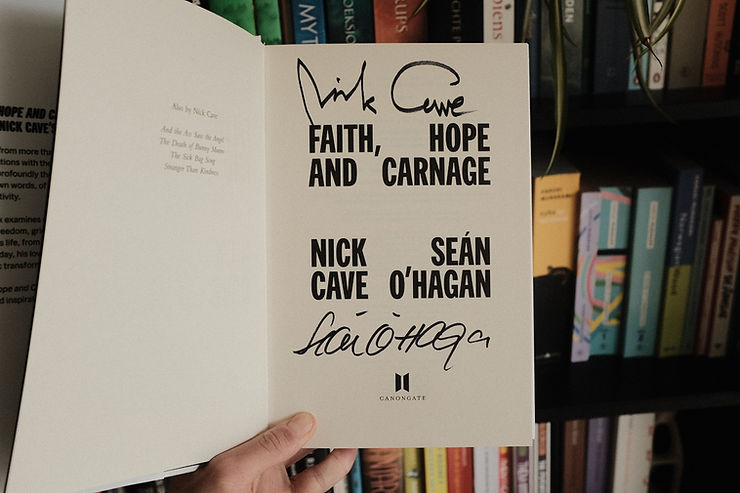
Around the release of Wild God, there are many interviews with Cave. In recent years, they’ve always covered the same themes: grief, religion and love. Cave has some beautiful and surprising ideas on these subjects. He also describes them in his book Faith, Hope and Carnage. In his online advice column, Red Hand Files, Cave has emerged in recent years as a counsellor; people confide their deepest problems to him. His concerts have become almost religious experiences.
For him, his songs have always been religious, he says in an interview with de Volkskrant (https://www.volkskrant.nl/volkskrant-magazine/nick-cave-i-think-we-shouldn’t-be-searching-diligently-for-what-we-believe-in-but-for-who-in-us-wants-to-believe~b5d6b315/). “I also like calling them that, because it scares people. And I want to restore the religious experience in my own way.”
Wild God moves from the cosmic to the religious and ultimately to the deeply human, says Cave. He wrestles with his demons every day. But even the rock star finds comfort. “When Susie woke up from her afternoon nap, she turned to me and said: ‘Everything will be alright, don’t worry.’”
PS.
Elon Musk wrote two years ago: “If Twitter wants to earn the public’s trust, it must be politically neutral, which means it must ruffle the feathers of the far right and the far left equally”. Two years on, things are somewhat different. X has become a pro-Trump machine, writes CNN’s Donie O’Sullivan. And it is running at full throttle, led by Musk himself.
Writer Warren Ellis (of the comic series Transmetropolitan and the Netflix series Castlevania, among others) has created an audio drama/radio play. The Department of Midnight consists of six episodes, three of which have been released so far. In each episode, you follow the no-nonsense scientist John Carnack as he solves a case. It always has a science fiction and horror element, a bit like The Twilight Zone and The X-Files. A nice change of pace in your podcast app.
---One Million Checkboxes was an online experiment featuring a million boxes that people all over the world could tick and untick. They have now all been ticked, and the experiment ended after two weeks. There’s a great story behind this fun website. Creator Nolen Royalty explains that he suddenly found strange URLs in the source code. Someone was trying to send him secret binary messages. Via a tick-box site. What?! This is am-az-ing.
---I’d really appreciate it if you subscribed to this newsletter. Every Sunday, I’ll send you a new edition free of charge. Sharing is brilliant!