
81. Unofficial Book Week
I.
Authors Marja Pruis, Pirkko Saiso and Nicolien Mizee are all known for works in which they observe their world from the first-person perspective. Hence, the evening at Utrecht Library was given the title I write about myself.
Pruis’s opening essay has been published online by the ILFU and deals in part with the smokescreen that writers in the first person must maintain. She cites her examples: Vivian Gornick, Sigrid Nunez and Elizabeth Strout. According to her, these are:
> “Writers who don’t make their writing look contrived, and yet at the same time you sense that it is an artificially achieved effect. I think it’s a certain kind of restraint, of control. But also the ability to maintain the appearance of authenticity, fearlessness, shamelessness.” > >
It was a recurring theme that evening. How, as a reader of a first-person narrative, you seem to crawl into the writer’s head, but that is never actually the case. Although, Nicolien Mizee claims that she describes nothing but the truth (in her brilliant Faxen aan Ger book series). Only to add: “My family and friends say I make it all up.”
The Finnish writer Pirkko Saiso also constantly blurs the lines between fact and fiction in her Helsinki trilogy, she says. Saiso has no qualms about tweaking her own memories to achieve the greatest possible dramatic effect.
In her work, she goes even further than the first-person narrator to describe her experiences. “Sometimes an event is so painful that you have to distance yourself from it,” she says. She takes this literally in her writing, by suddenly referring to herself not in the first person but in the third person.
II.
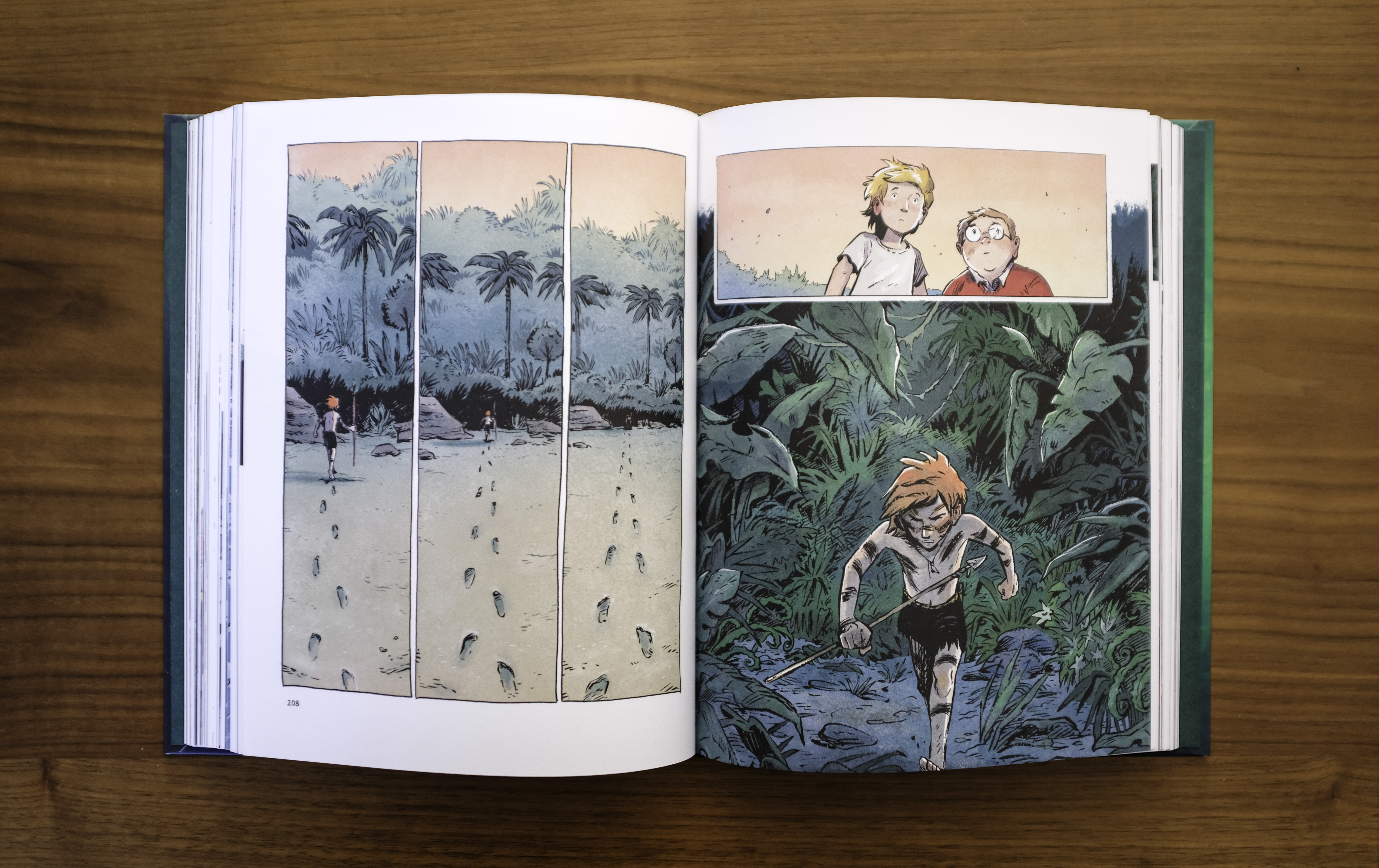
Aimée de Jongh is one of the Netherlands’ finest comic artists. She has proven this time and again, for example with the magnificent book Dagen van Zand. Her new book is yet another hit: the comic adaptation of William Golding’s classic novel Lord of the Flies. It tells the story of a group of children who must survive on a tropical island following a plane crash.
After the crash, the children manage to democratically appoint a leader who sets clear rules, enabling them to establish a functioning mini-society without adult help. But over time, children stray from the path and division—and later violence—arises. The story grows darker and darker.
De Jongh’s illustrations (a shout-out to the beautiful colouring, by the way) make the impact of the events palpable. There is one illustration in the book (not shown below) that bears a striking resemblance to the famous photograph of the Syrian boy who washed up on the beach at Bodrum in Turkey in 2015. At first, the image might feel harsh and out of place, until you realise: no, because that tragedy too showed our ‘civilisation’ at its ugliest.
III.
How long do you keep hoping things will get better before you can let go? That is the central question in Thomas Heerma van Voss’s novel Het archief. His protagonist, Pierre, is an editor at a literary magazine that was once highly regarded, but from which virtually all subscribers have now dropped out. Pierre isn’t quite sure what he wants, but his father is proud of him. Like his father, Pierre has ended up in the literary world, where he does important work for the arts. The rest of the world sees that impact somewhat less clearly.
In the first part of The Archive, you see the magazine’s ship slowly sinking. This is described in a sad yet witty manner. Such as when Pierre’s mother gently probes him to see if he wouldn’t rather look for another job. “The world is at your feet,” is her optimistic message, immediately followed by the painful addition: “It has been for years.”
In this part of the book, Heerma van Voss plods along quietly. As a reader, you’re given few stimuli, just like Pierre. He’s content where he is for now; what else can he do? He doesn’t let ambition get in the way of his comfort. But just as things start to get very monotonous, Heerma van Voss turns the dial and Pierre is forced to learn to let go when his father falls ill.
From that point on, the book becomes more dramatic, more serious and moving. The character traits of father and son are mirrored in each other. They don’t talk about an approaching end, don’t discuss loose ends, don’t get sentimental. They watch films from the past. “So there we lay, on either side, our eyes fixed on the same screen. We did what we’d done all our lives. We didn’t let the tears win.”
IV.
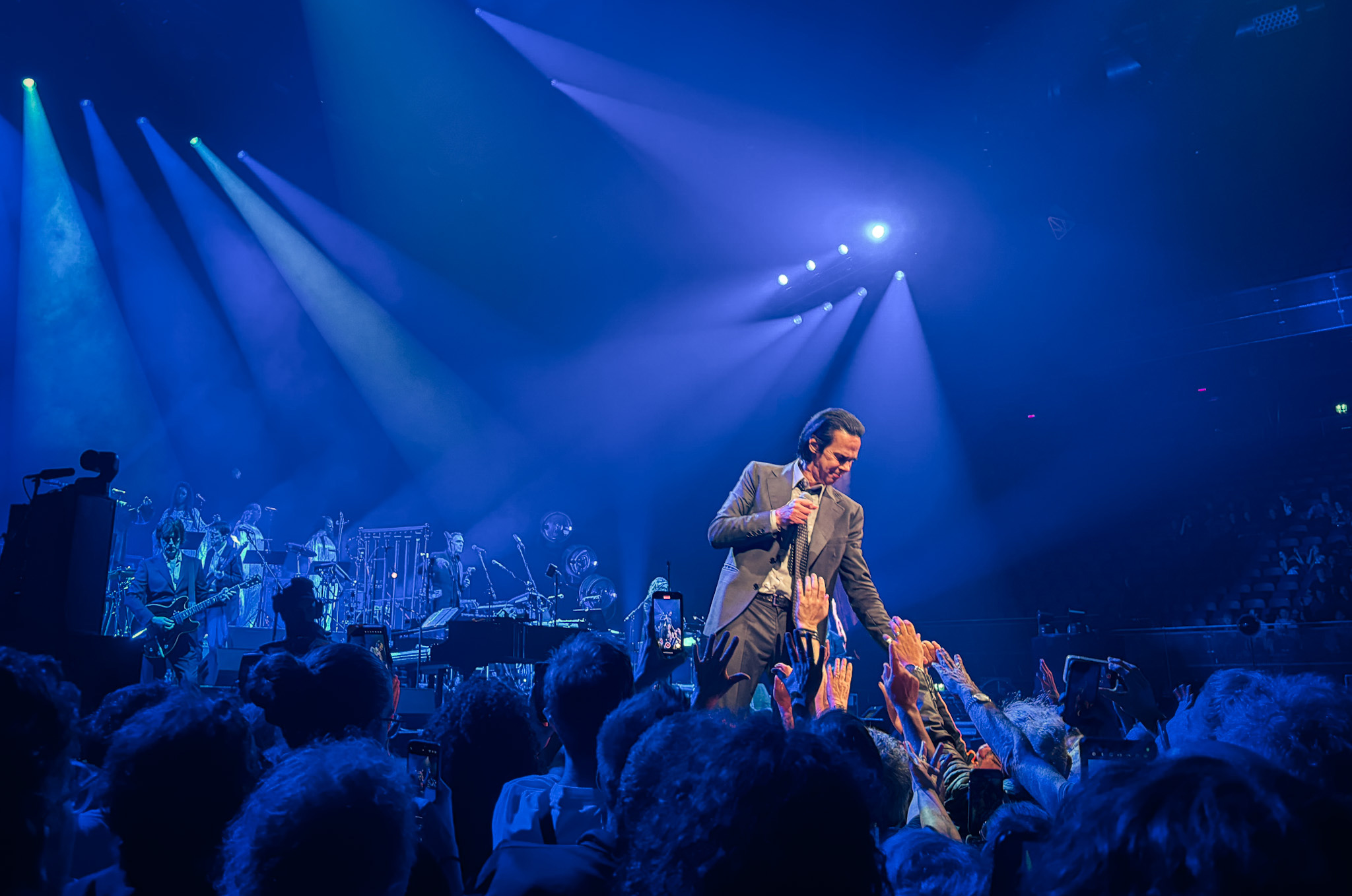
The concert by Nick Cave and the Bad Seeds (featuring Radiohead bassist Colin Greenwood) was one for the books. Cave joked about cuddly frogs, momentarily forgot how Red Right Hand began (“it’s been a few years since I watched Peaky Blinders”) and recounted how he used to rock his son to sleep whilst singing Papa Won’t Leave You, Henry (the child can’t have got much sleep).
The tone of the concert wasn’t as heavy as on previous occasions, though there were still plenty of songs that pierced right through my soul. The brilliant new Conversion, for example, and the set featuring Joy and I Need You.
Cave and the band were clearly enjoying themselves. When, after the first encore, ending with the gospel number As the Waters Cover The Sea, the main lights of the Ziggo Dome came on and people began shuffling towards the exit, the musicians suddenly returned. “We’ve got five minutes left, so we’ll just do one more,” shouted Cave. A magical concert, yet again.
PS.
Justice and Tame Impala were already a combination to savour. Now a lovely psychedelic anime video has been made for their track Neverender.
---Paulien Cornelisse is writing next year’s Book Week essay. The title: Hèhè – on what we say without realising it. On Eva Jinek’s show, she’s already shared some of the text and explained the concept. Because why do the Dutch (even when speaking another language) so often drop the little word ‘hè’ between their sentences?
---A round-up of dystopian tech news:
-
James Cameron, who once issued a warning about AI with his film Terminator, has joined the board of Stability AI. That company generates images based on text input.
-
Great story from Bloomberg: how an army of Russian bots made millions from online poker games.
-
The graphing calculator that has been providing secondary school pupils with digital cheat sheets during exams for years is now completely unstoppable. Someone got ChatGPT working on the Texas Instruments TI-84.
-
Mark Zuckerberg has completely lost interest in political involvement. So he is withdrawing from it (along with Meta) as much as possible.
-
The London newspaper Evening Standard has plans to bring film critic Brian Sewell back to life using AI, almost ten years after his death. So that his virtual spirit can pen scathing pieces. (A rare bad idea, I might add.)
-
Excellent tweet about AI rubbish. “The conversation about AI begins and ends with that episode of SpongeBob, in which King Neptune uses magical powers to make hundreds of disgusting Krabby Patties and SpongeBob eventually lovingly prepares a delicious Krabby Patty.”
Put Francis Ford Coppola in a room full of DVDs and you’ll hear the most wonderful stories.
---Willem, together with Yousef Gnaoui and Milan van Dril, made a lovely promotional film for his album Spuug van God, released earlier this year.
---Next year, the sequel to Ghost of Tsushima will be released for the PlayStation 5. The game promises a story set centuries after the first instalment, centred around Mount Yōtei (not to be confused with Fuji). The trailer for Ghost of Yōtei features a shot of the lead actress standing in front of that mountain, and it’s absolutely stunning.
---And The Cure are back! After sixteen years, there’s a new track: Alone. The band takes its time with the intro, and then Robert Smith’s familiar voice suddenly cuts in. Ah, the melancholy.
---I’m reading Intermezzo, Sally Rooney’s new novel. Just looking at the book cover makes me want to read on. More later!
I’d really appreciate it if you’d subscribe to this newsletter. Every Sunday, I’ll send you a new edition free of charge. Tips and feedback are always welcome!