
90. Beatlemania, 60 years on
A few months after the assassination of President John F. Kennedy, The Beatles visited the United States. This is how the new documentary Beatles ’64 on Disney+ begins. But even in this grieving nation, John, Paul, George and Ringo encountered a familiar sight from their homeland: screaming girls. Lots of screaming girls.
We see the band messing about in their hotel rooms. They met their musical heroes and constantly carried a small radio with them, on which their songs were played non-stop. During interviews, they were disruptive. They couldn’t help it. “Everyone from Liverpool is a comedian,” George Harrison later said of this.
The footage shot during their trip to America has been beautifully polished for the film. In between, there are new interviews with Paul McCartney and Ringo Starr, which add little, and with fans who were there during the tour. I could have done without them, though it is of course wonderful that David Lynch makes an appearance, rambling in a thoroughly Lynchian manner about the phenomenon of music. “Certain music can make the heart swell until it almost bursts,” he says, beaming and with increasing intensity. “Tears of joy flow from your eyes. You can’t believe the splendour that is coming.”
Beatles ’64 returns to the Kennedy assassination a few more times, but unfortunately the documentary fails to maintain that central thread. During their time in the US, Lennon is said to have been concerned about the violence in the country. A joyful crowd could easily turn into something violent. We don’t see that reflected here.
McCartney, too, makes it seem bigger in hindsight than we can see in the footage. “Perhaps America needed something like The Beatles to emerge from its mourning and show that life goes on,” he says. “The joy you see in the crowds is as if they’re being lifted out of their grief.”
Perhaps. I mainly see young Brits conquering the world with incredible music.
---II.
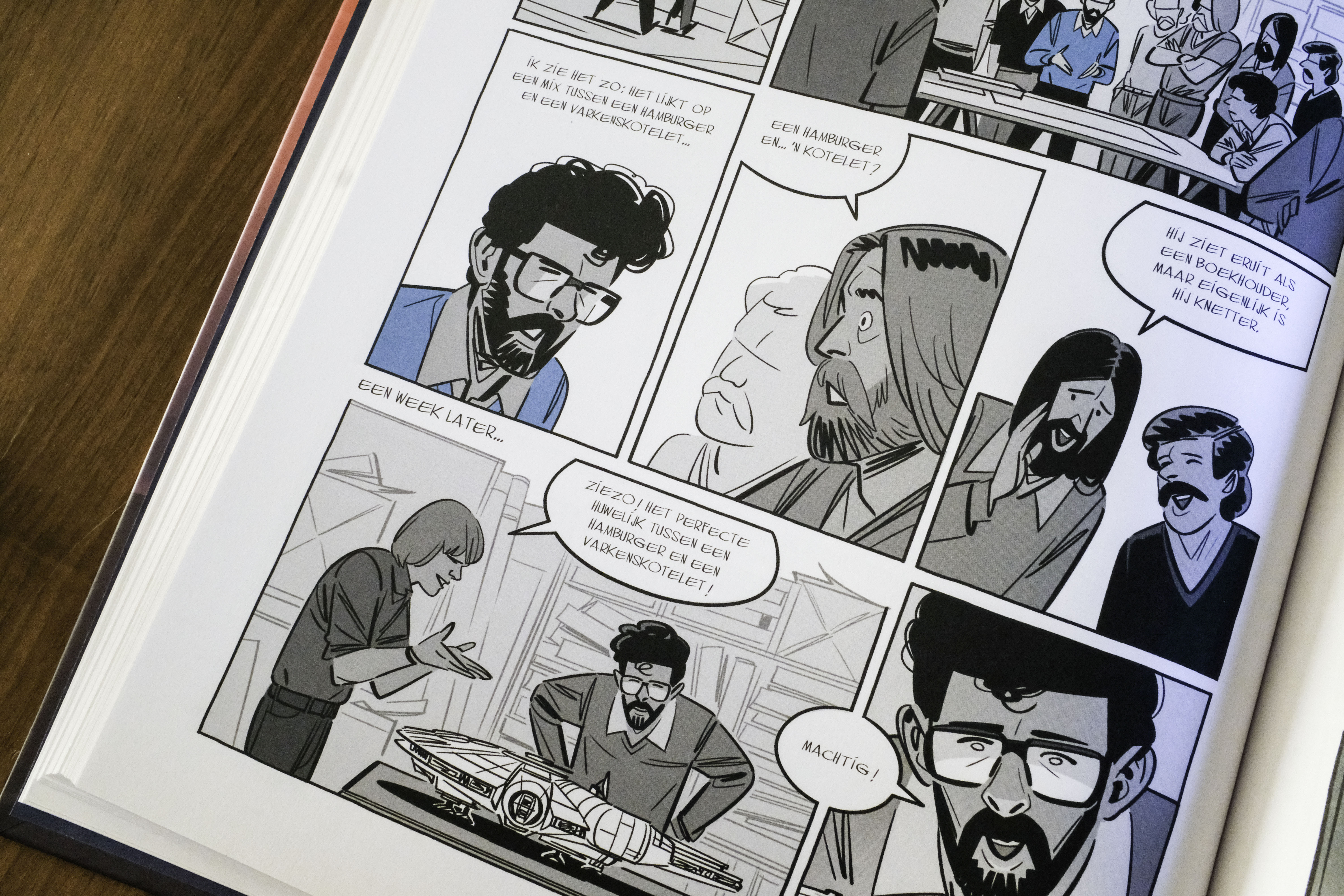
After much hesitation, I decided to give the graphic novel Lucas Wars a go. Hesitation, because: how fascinating can a biographical ‘making of’ of a film be in comic form? Well, the book has kicked off yet another Star Wars marathon here at home. So, super fascinating.
Lucas Wars is about the making of the very first Star Wars (1977). You follow the struggles of the young, stoic director George Lucas. Virtually no one sees the merit in his idea for a pulpy space epic with lots of special effects. Eventually, he secured a small sum of money from 20th Century Fox, but even this studio (the only one showing interest) tried to thwart his film because the suits expected it to be a flop. With the benefit of hindsight, you read the story with utter amazement. It also turns Lucas’s perseverance into a heroic tale. The rebels always win.
At first glance, the drawings seem simple, but the lines are drawn with enviable precision. With just a few brushstrokes, illustrator Renaud Roche captures the distinctive faces of celebrities such as George Lucas, Steven Spielberg, Harrison Ford and Alec Guinness. The lack of detail keeps things lively and adds pace to the story, which is skilfully written by Laurent Hopman. Packed with facts about Lucas and the actors, and with nods to other directors and films. Feel free to add it to your Christmas wish list.
III.
Australia is taking the lead, as the first country in the world: if you’re under 16, you’ll no longer be able to access social media there. This age limit is being introduced because the Australians see no other solution to counter the harmful effects of social media platforms. Apps such as Facebook, TikTok, Snapchat and Instagram have been given a year to comply with the new rules. If they do not do enough to prevent children from accessing the services, they can expect fines running into millions.
This will, of course, be a major headache. There have been frequent calls for age verification, but the code to do this in a privacy-friendly and watertight manner has not yet been cracked.
In Europe, we are not yet fans of this sort of ban. Social media isn’t all bad; for example, it helps children find information and like-minded people. Don’t underestimate that last point; otherwise, I’d be happy to point you once again to the Netflix documentary The Remarkable Life of Ibelin.
This week, I particularly enjoyed LinkedIn’s attempt to convince Australian policymakers that the platform is too boring for children. They’re even resorting to the truth to get out of the ban.
PS.
I write this regularly, but now you’re hearing it from someone else: For the love of God, make your own website.
Your father passes away and you discover he has left behind 300,000 comics, including one of the rarest in the world: the first Superman comic. You could easily fetch 3.5 million dollars for it. That’s what the documentary series Selling Superman is about; it’s partly a family portrait and attempts to explain the phenomenon of collecting. It’s always fascinating that we attach value to objects without knowing what will remain of them after we die.
---A lovely online production: Inside Kristallnacht. You experience the story of Charlotte Knobloch, a survivor of Kristallnacht in Munich. That night, Jews and their homes, schools and shops were attacked throughout Germany. Knobloch was six years old at the time and now, at the age of 92, recounts her experiences.
Kevin Parker (Tame Impala) is launching a synthesiser. It’s called the Orchid and is described by Telepathic Instruments as an ‘idea machine’. Great promotional video.
---The Smile (comprising various Radiohead members) formed at the start of the coronavirus pandemic. They collaborated with director Paul Thomas Anderson on videos for their songs. This video essay brings it all together:
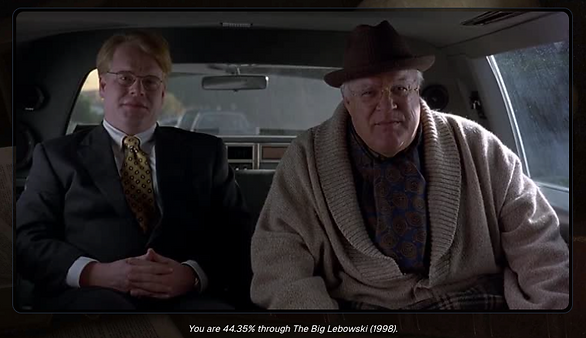
---It was my birthday this week, and that was a good moment to confront my own mortality via the website Memento Movi. Based on an average life expectancy of 79 years, I am at 44.35 per cent. Using dozens of films, the website shows at which point in those films I am currently (almost halfway through). In the case of The Big Lebowski, for example, that is the moment when The Dude has to explain himself to The Big Lebowski and his right-hand man Brandt in a car about the progress of his investigation into the disappearance of Bunny Lebowski.
Incidentally, I read the Donald Duck comic that was in the shops when I was born. Back then, there was still a florin on Scrooge McDuck’s money bin, and you could save guilders with a Pennie Rekening piggy bank.
This is a lovely piece in the NRC about non-existent words in the Van Dale dictionary and non-existent places in atlases. These aren’t mistakes; they’re added deliberately so that competitors can be caught if they try to copy them. (Timbuktu actually does exist, by the way.)
My heart skipped a beat: Bright Magazine is coming back! When I was a trainee tech journalist at Bright (and was able to hang around for years afterwards), the magazine still existed. I’ve still got a few copies lying around. Like so many print publications, Bright Magazine eventually disappeared, but a new edition is due out in February, naturally packed with innovation, to mark Bright’s twentieth anniversary. The plan is for the magazine to be published annually from then on. You can pre-order it here.
Thanks for reading! Are you already a subscriber?