98. Sketches and sculptures at De Kunsthal
I.
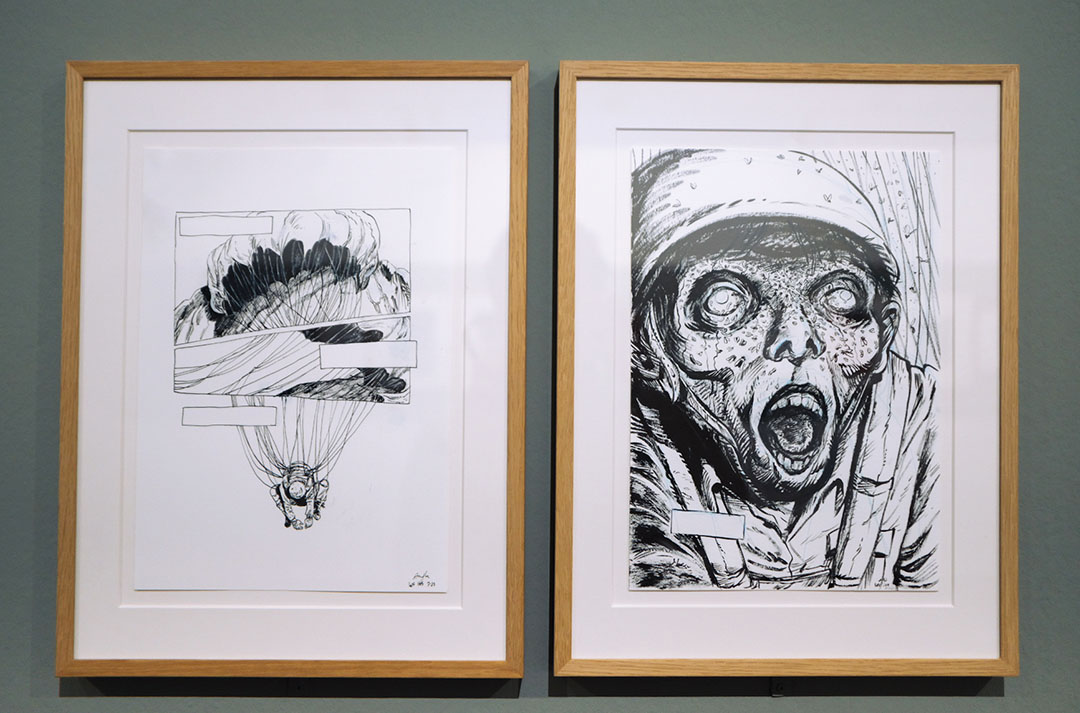
An exhibition dedicated to Aimée de Jongh is on display at De Kunsthal for another week. The Netherlands’ most famous illustrator has (rightly) achieved enormous international success with her adaptation of Lord of the Flies. In Rotterdam, original ink drawings hang alongside the final versions of all the highlights from the book. You can still see the blue sketch lines, yet it is striking just how accurately De Jongh draws.
There are also sections dedicated to the graphic novels Sixty Springs and my favourite: Days of Sand. There are a few sketchbooks lying open on glass tables, of which I would have liked to see a few more. After all, that is the most intimate and raw work you can view. They are unfiltered, unpolished ideas on paper. She took the sketchbooks with her to Lesbos in Greece, where she was sent by NRC to a refugee camp to produce journalistic reports. Photography wasn’t allowed there, so she drew what she saw. People, surroundings and stories. On display and to read at De Kunsthal – wonderful.
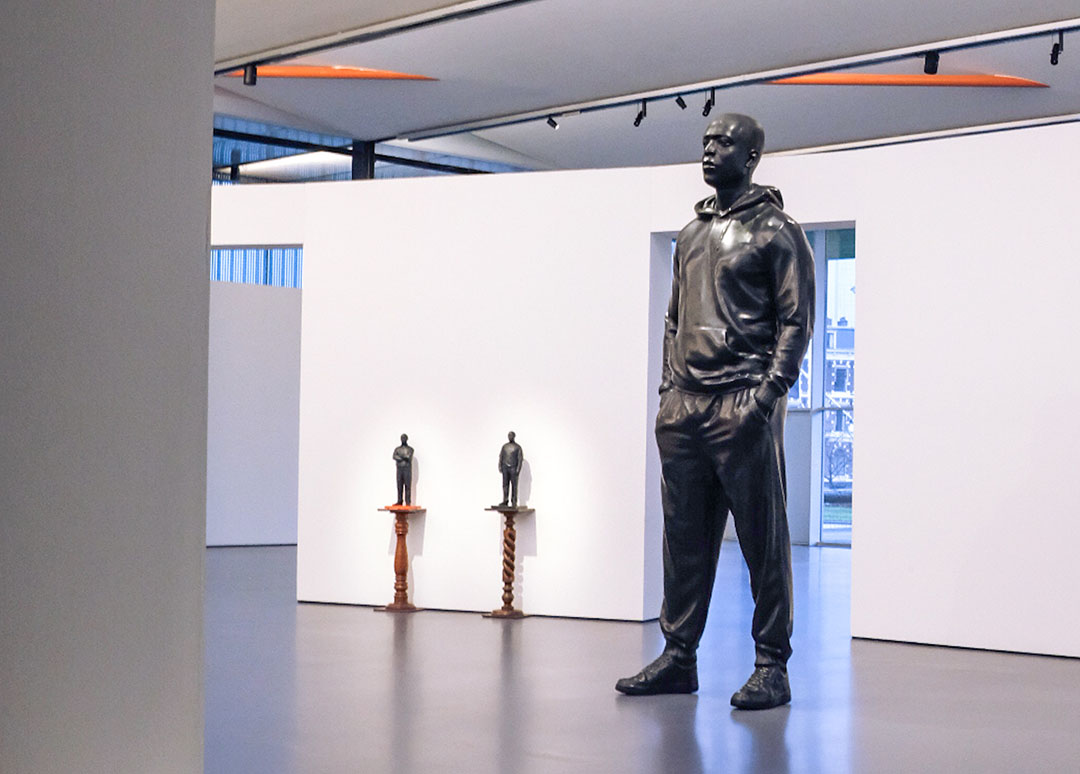
Alongside De Jongh’s work, the museum has dedicated an entire floor to the sculptures of British artist Thomas J Price until 9 February. You’ve probably seen his work before at Rotterdam Central Station: the large bronze statue of a young black woman in a pair of Nikes, with her hands in her pockets. That’s the beauty of his sculptures. They are entirely matt black, white or shiny gold, yet they represent the modern rather than the classical human form.
“I’m interested in the way we interpret identity from sculptures,” Price told De Volkskrant in October (https://www.volkskrant.nl/tentoonstellingen/hype-en-een-rel-metershoge-sculptuur-van-zwarte-vrouw-voor-rotterdam-cs~bb23902f/). “In ancient art, we can recognise figures by their attributes; such as Hermes by his winged sandals. That’s how I think about the clothing and accessories of my characters too. What happens when a character is dressed casually? A phone also says something about a person. I usually create figures who are alone, but a phone is a kind of portal; then you’re no longer alone.”
II.
I dreamt about a large owl this week. At first it was perched on the fence, and when I looked again later, it was sitting on the shed. It looked me straight in the eye. Perhaps it means nothing, because those birds are never what they seem, but it might well have something to do with my excessive consumption of everything to do with David Lynch. Here is a selection:
-
Laura Dern has perhaps written the most beautiful article. She published a personal letter in the Los Angeles Times Times, addressed to the director. “You have forever transformed all of art, be it film or music or painting or cartoons or giving the weather report — all of it became a space for dreaming.”
-
Kyle MacLachlan praises Lynch’s courage in always following his instincts. “At some point I know he said, ‘I’m just gonna follow my creative intuition.’ And that’s not easy. You think about it as an artist — and speaking for myself — I’m much more comfortable compromising, or perhaps questioning, my own instincts.” A wonderful lecture. Who dares to do that?
-
Twin Peaks co-creator Mark Frost and part of the cast reminisce in The Guardian about making the series and the director. A bonus tip from me if you want to know more about the making of Twin Peaks is the book Reflections: An Oral History of Twin Peaks by Brad Dukes.
-
Peter Bogert writes at length in his film newsletter about David Lynch, whom he calls a “modern Renaissance man”, based on three of his films.
-
Lynchian.com collects stories and tributes from people who have had dealings with Lynch.
-
Fix Your Heart or Die: The Startling Empathy of David Lynch. An older article, well worth a read. Don’t read it if you’ve never seen Twin Peaks, as it contains massive spoilers.
-
The latest podcast episode of St. Paul’s Boutique is entirely dedicated to David Lynch. Our DJ speaks with, among others, director Jeroen Houben, DJ Joost van Bellen and NRC journalist Thijs Schrik about the artist’s impact on their lives. (This also contains a spoiler for Twin Peaks).
-
Over the coming week, the better arthouse cinemas will once again be screening Lynch’s work. Don’t miss your chance to see Blue Velvet, Mulholland Drive or Lost Highway on the big screen, for example.
III.
Blood on the Tracks is fifty years old. I think it’s one of Bob Dylan’s finest albums. It’s full of such beautiful imagery. Right from the opening lines of Tangled Up In Blue:
> Early one morning the sun was shining > I was lying in bed > Wondering if she’d changed at all > If her hair was still red > >
And in Simple Twist of Fate:
> He woke up, the room was bare > He didn’t see her anywhere > He told himself he didn’t care > Pushed the window open wide > Felt an emptiness inside > To which he just could not relate > Brought on by a simple twist of fate > >
I often find Dylan at his best when he sings that things are going well, even though they aren’t. He does this frequently on Blood on the Tracks, but the song Most of the Time (released on Oh Mercy in 1989) takes that premise to perfection.
---PS.
Elon Musk stole the show at Donald Trump’s inauguration. There’s been a whole week of debate about his outstretched arm. The Hollywood Reporter has made up its mind: sometimes a Nazi salute is just a Nazi salute.
This week I used this little tool to delete all my posts from X. Simple and free.
Craig Mod writes in his acclaimed monthly blog Roden about his love-hate relationship with social media. “Modern social media are so far removed from what that reverse-chronological timeline was in 2007 that it’s delusional to still call them the same thing,” he writes. For him, social media are about sharing content created elsewhere. According to him, social media are not “the places where art is created”.
A lovely little get-together this, by Wende and Abel. They played a cover of Shallow from A Star Is Born at Bar Laat. In Dutch, that translates to something like Schaduw.
Abel also gave five book recommendations on the Athenaeum bookshop website. “I think it’s healthy to read a thick, old and intimidatingly thick book every now and then – one you’re afraid of. That’s good for the soul.”
Two Dutch directors have been nominated for an Oscar for their short films. Both can be viewed online.
I Am Not a Robot by Victoria Warmerdam is about a woman who fails a CAPTCHA test.
And *Wander to Wonder* by Nina Gantz is about three puppets who starred in a children’s series. When their creator dies, they are left behind in the studio. They grow hungry and fall into disrepair, but they continue to make new episodes. These become increasingly strange. ---Thanks for reading! Are you already a subscriber?