
139. The elusive Bob Dylan
I.
In reviews I read that Bob Dylan was nowhere to be seen by the audience in Amsterdam this week. Only a tuft of hair protruded above the piano. From the right-hand side of the hall I had a perfect view. Although, with Bob Dylan you can always be sure of one thing: you don’t see him. Even when you see everything.
The elusive Bob Dylan has existed ever since he turned up in New York. This week I read the book Rolling Thunder Logbook by Sam Shepard, who kept notes during the Rolling Thunder Revue in the 1970s. “Faced with him in the flesh, I have a hard time shaking loose of the photographs and just seeing him”, he writes about his first encounter with Dylan. “All I’m seeing are album covers for about six minutes straight. Then slowly he comes into focus.”
That focus never comes on stage. I happen to be on the right side of the stage, but there are some rather ill-placed spotlights next to the piano, meaning you never really get a good look at the old singer. This has advantages for both sides: Dylan doesn’t have to pose as an entertainer and the myth is preserved. At the end of the concert, fans (of all ages) rush towards the stage to get as close to Dylan as possible.
Between the lines, Shepard makes a few insightful observations about Dylan’s concerts that still hold true fifty years later. “It’s just a building and then a whole world enters into it and takes it over and then goes away again”, he writes. Dylan might just walk onto the stage too early. “He’s always got the jump on the audience that way. He knows he’s out there way before they do, and it gives him the edge every time.”
It’s always a game with Dylan. It’s never boring. You’re on the edge of your seat. He can ruin entire guitar pieces, get it completely wrong on the piano, and then take you by surprise with phenomenal renditions of Desolation Row and It’s All Over Now, Baby Blue.
That’s why it continues to fascinate me. “Dylan is an invention of his own mind,” writes Shepard. “The point isn’t to figure him out but to take him in.” You could also say that Dylan is therefore an invention of your own mind. That’s why Bob Dylan will always exist.
II.
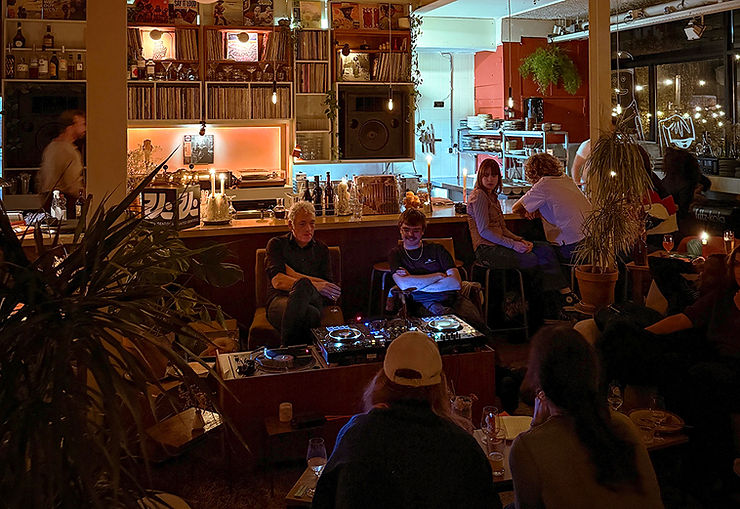
At the lovely Utrecht listening bar Nomono (which is facing closure at the end of December), DJ and producer Carista regularly organises listening sessions. She invites artists to come and play records right in the middle of the venue. Surrounding them, visitors sit in a living-room setting drinking wine. It’s very accessible and relaxed. Occasionally the artists say a few words, but it’s mainly just about enjoying the music.
This time, Spinvis is the guest. Erik de Jong walks in with a crate of LPs. He plays all sorts of things, but mainly Dutch artists from the indie and underground scenes. A few times we hear tracks from the album he made with Simon Vinkenoog. We hear the poet reciting his lyrics over experimental jazz and electro beats by Spinvis.
Amerika + Bang zullen ze leven is played, by Roos Rebergen (Roosbeef!) together with the five-piece string ensemble SunSunSun Orchestra. I make a note: I’ll have to give the album a listen later. Rebergen’s voice together with the strings sounds like a perfect match. “I’m a cowboy,” she says in the song’s outro. “A real one. But nobody sees it. Because they’re afraid. Afraid they’ll live.”
Something else I’m noting down: Fulco. One of those artists who, according to De Jong, isn’t heard nearly often enough. Indeed, the name means nothing to me. He plays two tracks from the album Het Vermoeden. Doortocht (Ulm) seems like a simple guitar song, until just past the halfway point more instruments swell in and a lovely short seventies synth solo seeps through. Not long after, Fulco’s Aanbevelingsbrief is played, with a hint of Spinvis’s style coming through.
Finally, De Jong conjures a blank record sleeve from his magic box. It’s going to be an experiment, he says. “This is a lacquer disc from my father’s estate. No idea if it still works or what’s on it. It probably hasn’t been played for 80 years.”
How extraordinary, then, that we are all listening to a crackly, hissing record, on which a beautiful woman’s voice can be heard, accompanied by a cinematic orchestra? A ghostly voice.
PS.
There is a lot hidden in this little sentence by Herman Martinus: “I never wanted to carry the internet around in my pocket”. It would be much more peaceful if we could only go online in designated places. That used to happen at home at the computer desk, an object that seems to have disappeared with the advent of the smartphone and ubiquitous internet. Martinus’s blog is about the ongoing struggle to wean oneself off phones and algorithms. “The underlying premise here is that if you’re trying to lose weight, you shouldn’t carry cookies around in your pockets. And my phone is the bag of cookies in this metaphor.”
With LEGO, you can build anything, even a bowl with windows. (via Kottke)
You’ve just read blog post №139, written during the week of 3 to 9 November 2025. Subscribe to my newsletter and you’ll receive it in your inbox every Sunday, free of charge.