
130. A couple of stoners watching birds
I.
Here’s another gem from the YouTube algorithm. The film LISTERS: A Glimpse Into Extreme Birdwatching is about two brothers who decide to go birdwatching. “One day I got high and found our family’s bird book,” says Quentin Reiser. “And I thought how strange it would be if you knew all those birds in that book. Just how bizarre that would be.”
Quentin looks like a stoner, he talks like a stoner and he thinks like a stoner. He knows next to nothing about birds, but still manages to infect his brother Owen with the birdwatching bug. They go all out and set off in a minivan to spend a year travelling around the United States with no other aim than birdwatching and filming.
The result is a documentary of almost two hours in which home-video-style footage is interspersed with fantastic shots of beautiful birds. The brothers find themselves in a world of highly fanatical birdwatchers, who go to great lengths to see as many species as possible. The competition mainly takes place via the eBird app, where people climb the rankings by ticking off birds (ha!). A sort of Pokémon: catch ’em all.
I find it absurd to think that LISTERS was made by two amateurs with a ridiculous idea, and that such a delightful film came out of it. The passion shines through, it’s witty (sometimes verging on the corny) and the documentary has real momentum. The brothers also touch on the downsides of their venture (and of extreme birding). After YouTube kept suggesting the video to me a few times, I gave in, thinking I’d just watch it for a couple of minutes. Then I couldn’t stop.
- - -II.
Warning: spoilers for Suske en Wiske follow. The album De helden van Amoras 1, to be precise. THAT ALBUM WHERE SUSKE AND WISKE KISS. The world was turned upside down when it became known. Although they had already shared a passionate kiss back in 1947, but that’s beside the point.

The Heroes of Amoras is a new spin-off series by Marc Legendre and Charel Cambré. They previously created the comic series Amoras. Also featuring Sus and Wis, and also aimed at an older audience. The creators knew exactly what they were doing by putting Suske and Wiske kissing on the cover, of course. Stories and reactions appeared all over the media. It was said to be the first time in their eighty-year history that this had happened; vox pops on the street filmed shocked passers-by. “I thought they were brother and sister,” was a common reaction.
You can even read the same reaction within the comic itself, when one of the pub patrons sees Suske and Wiske with their arms around each other’s necks. Legendre and Cambré obviously knew what their stunt would cause. Free publicity! And yet… they didn’t quite dare to have Suske and Wiske actually kiss. Because in reality, these aren’t our heroes at all, but villains in disguise trying to trick Suske and Wiske.
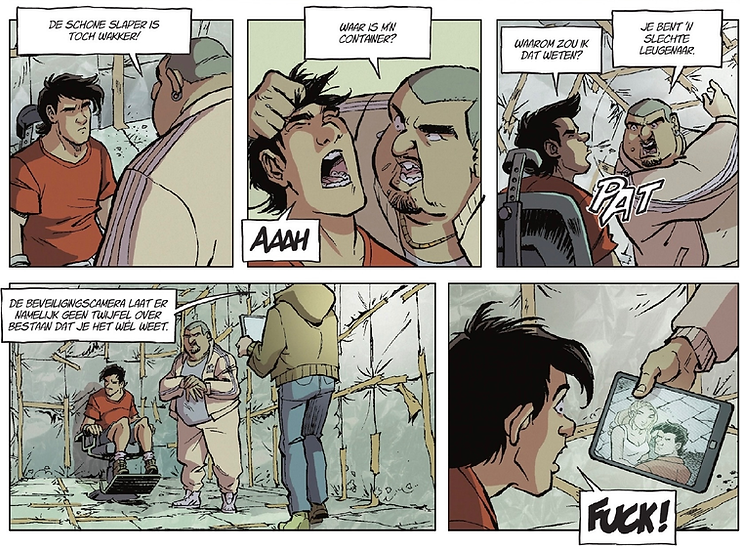
I found it far more bizarre than the kiss to see Suske (the real one) sitting in a torture container. A torture container! That really hasn’t happened before in eighty years of Suske and Wiske. But then again, you don’t hear a peep about that.
III.
After David Lynch’s death, I read such lovely stories about what Twin Peaks had meant to fans. That TV series is magical and, although it inspired so many other shows, nothing can hold a candle to Twin Peaks. It’s too strange. Too elusive. That’s what makes it such a wonderful series to write about, and at the same time, it keeps the spirit and world of David Lynch alive.
Twin Peaks is the sort of series you either can’t relate to at all, or it takes over your life. There’s no middle ground. If you know, you know. I happily watch hours-long essays about the series or read books on it. If it clicks, then you’re my sort of person. Mark Moorman and Alex Mazereeuw are therefore my kind of people. They ranked episode eight of Twin Peaks: The Return (from 2017) as number 1 on their Volkskrant list of the sixty best episodes of series released this century.
“Lynch literally takes us into the ‘birth’ of evil, by letting the camera go deep into the explosion,” they write. “Evil has never been as beautiful as in this episode, and suddenly gave a whole new context to the already elusive mythology of the series. With this avant-garde masterpiece, Lynch and Frost demonstrated once again that the boundaries of what is possible on television can always be pushed further. Of all the overwhelming, moving, funny, unforgettable series, this was the episode that left us utterly devastated every time we watched it.”
God, yes, episode eight of that third season. I didn’t know what I was seeing. An atomic bomb and all sorts of alienating black-and-white images. I didn’t understand a thing, but I enjoyed it to the full. Pure art. Twin Peaks co-creator Mark Frost describes the wonder to De Volkskrant: “David was, of course, unrivalled in this regard. The nuclear explosion took up barely a paragraph in the script, but David turned that into thirteen of the most breathtaking minutes of television ever. I think it’s one of the best things he’s ever made, and that’s saying something, given his body of work.”
Just for fun, I looked up a few articles by TV critics who had to make sense of it all at the time. “After this bewilderingly brave and groundbreaking hour of television, David Lynch has outdone himself,” writes Dan Martin in The Guardian. “What an unforgettable journey.” Matt Zoller Seitz writes for Vulture: “The eighth episode of Twin Peaks: The Return is one of the greatest hours of television I’ve ever seen: horrifying, horrifyingly beautiful, thought-provoking and thought-annihilating; a work that owes as much to expressionistic and surreal painting, musical performance, and installation art as it does to narrative and experimental cinema.”
And Noel Murray reports in The New York Times: “There is nothing in the history of television that helps describe exactly what this episode attempts. Not even the jarring nightmare sequences from the original series were anything like this hour, which jumps around in time and space in ways that at times seem almost like free association.”
There’s nothing quite like Twin Peaks. I’m immediately keen to watch it again.
- - -PS.
The best news of the week: Radiohead are back! After seven years, the band has suddenly announced twenty concerts for this autumn. That’s all for now. Unfortunately, Dutch fans will have to travel abroad. I hope to be selected for a concert in Berlin, but the best thing would be if Radiohead got the bug again and extended their tour to include Amsterdam. (I don’t even dare to dream of a new album.)
Matt Berninger performed at TivoliVredenburg and was clearly having a great time. The glasses of vodka no doubt contributed to that, but so did the absence of the high expectations that usually come with a concert by The National. I had a bit of a laugh during All for Nothing. That song starts with the line: “Standing in the quicksand with a smiling face / I don’t mean to bother”. Berninger likes to act out his lyrics on stage, and so the line comes to life in a Charlie Chaplin-esque slapstick style. Keep smiling and wave for a moment whilst you slowly sink into misery. A brilliant concert. You might still be able to buy a ticket on Ticketswap for the second concert in Utrecht, next Tuesday.
Chloé Zhao is directing Hamnet, based on a novel by Maggie O’Farrell. It’s about William Shakespeare and his wife Agnes in the period following the death of their 11-year-old son. Starring Paul Mescal and Jessie Buckley. In cinemas from late January.
- - -Journalist Alissa Wilkinson visited the Sphere in Las Vegas. That’s the enormous sphere made up of screens on both the inside and outside. U2 performed there, and now you can watch films there too. The 1939 film The Wizard of Oz has now been adapted for viewing there. It’s a unique experience, writes Wilkinson. Though it also sounds like a nightmare. “There is something disconcerting about this particular Wizard of Oz: it suggests that in the future, every artist’s choices could be reversed, altered or ripped to shreds, then presented by their corporate owners as if they’re essentially the original, just spruced up a bit for a new century.”
Here’s a bit of inspiration from Harvard professor Arthur C. Brooks. He says: “Bore yourself a bit more”. We’re not very good at that, because we fill every spare moment of the day with our phone, a podcast or a video.
- - -Bas Heijne’s essays (https://www.nrc.nl/nieuws/2025/09/03/kutwijf-ooit-was-de-vvd-een-goedlachse-partij-a4904928) are always a joy to read: “You’d almost forget it, but once upon a time the VVD was a champion at laughing things off. Led by Mark Rutte (‘Heyyy!’) and Gerrit Zalm, for years every opposition and criticism was crushed almost carelessly under a steamroller of liberal bonhomie.” A steamroller of liberal bonhomie!
This video made me want to buy a Kindle, for all the right reasons that have nothing to do with Amazon. (But I’m not buying one.)
- - -You’ve just read blog post №130, written during the week of 1–7 September 2025. Subscribe to my free newsletter to receive this blog in your inbox every Sunday.