147. A magazine that is 100 years old
Hello everyone —
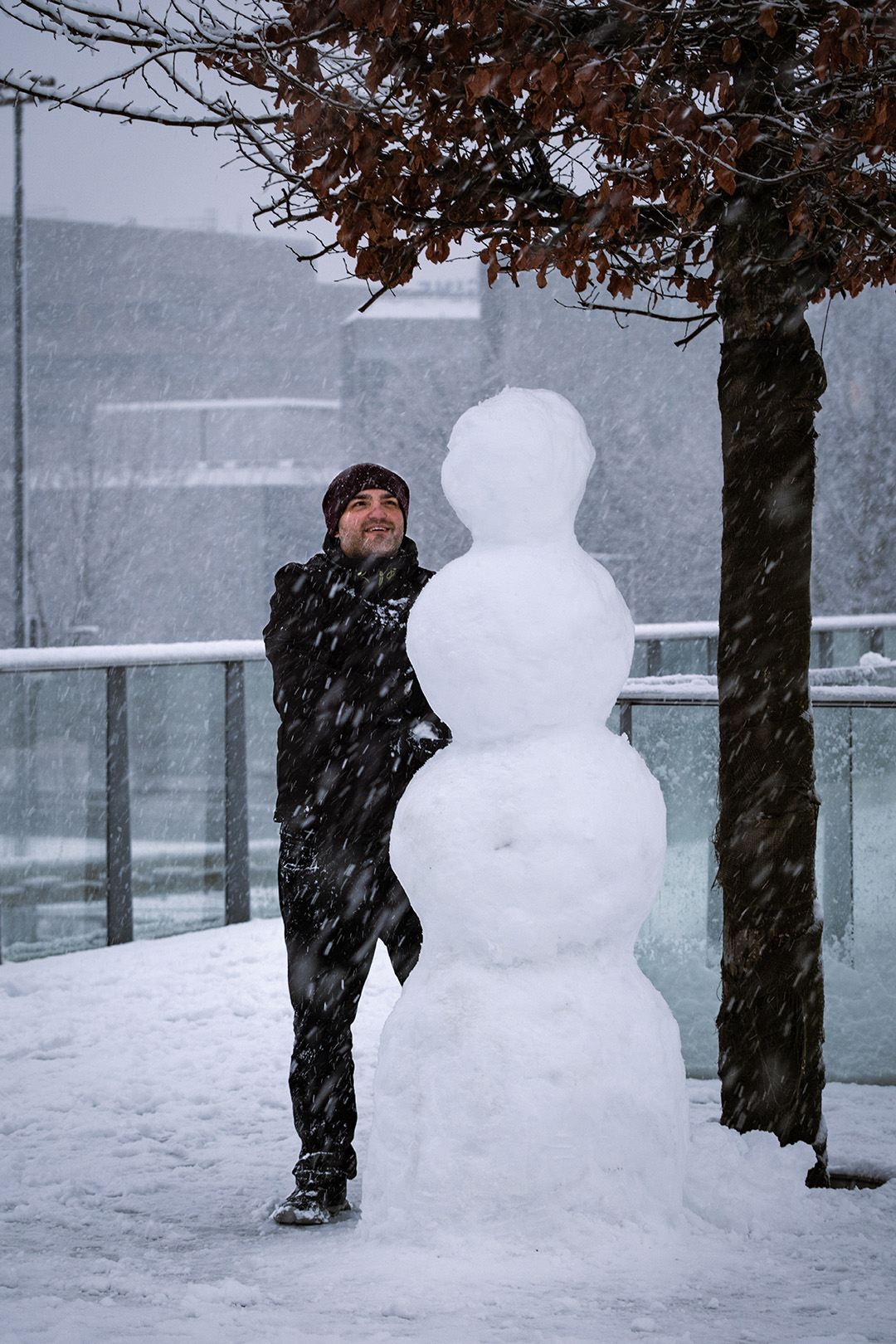
Happy New Year. I’m writing to you from a snow-bound Utrecht. Cars are crawling through the grey slush and cyclists are skidding past. We Dutch, we never stop cycling. This morning I walked through the city — 16,000 steps before noon. I saw a man building a snowman on the bridge near Utrecht Central Station. All on his own, with a big smile. When I passed by again an hour later, he was still at it. You can see him in the photo at the end of this blog. He spoke English: “Almost done!” The joy of a layer of snow (everything is different!) does people good, even if only for a few hours. Soon the flattened flakes will turn into a layer of ice and then it will start to thaw. I shan’t get ahead of myself and will just enjoy it for a while longer.
Let’s get started with the blog. I’ve seen two documentaries.
I.
For me, a large part of the appeal of The New Yorker magazine lies in the design of the cover: always an illustration with the magazine’s title above it — in that perfect typeface, created by Rea Irvin in 1925. They are lovely, minimalist covers. No teasers, no garish quotes.
Not that I pore over the magazine every week, but I do regularly read a profile (this one on Willie Nelson, for example), Richard Brody’s film reviews or the short stories by Haruki Murakami or David Sedaris. Every now and then, the magazine publishes an article you simply cannot ignore. The 2017 story Cat Person was one such piece.
Last year, The New Yorker celebrated its 100th anniversary, prompting the creation of a documentary about the weekly magazine, which is now available on Netflix. It is a celebration of the brand, featuring mainly highlights. The history of The New Yorker is recounted, featuring key stories such as John Hersey’s Hiroshima and In Cold Blood by Truman Capote) are given a place in the spotlight.
The New Yorker at 100 is also an ode to (the romance of) journalism. We tag along with a reporter who takes to the streets in the old-fashioned way, with pen and paper. We hear the reflections of a writer who compares a Trump rally to a gathering of Nazis at Madison Square Garden. The film conveys a love for the profession that you, as a reader, don’t always get to experience and that journalists sometimes forget.
The New Yorker has an editorial team that is second to none. The fact-checking team alone consists of 29 people. They scrutinise writers’ stories down to the smallest detail. They ring sources to ask whether the writer was indeed offered tea upon arrival. Or was it coffee after all? Even the cartoons are scrutinised. Does the angle of the sunlight match the character’s shadow? It seems terribly intimidating for the creators, but this is how The New Yorker maintains its high standards.
I would have liked to see more of the setbacks the magazine undoubtedly faces, but this isn’t that sort of film. This is a well-deserved tribute to a wonderful magazine that demonstrates that the written word still possesses enormous power. It made me want to read and write.
- - -II.
John Lennon and Yoko Ono lived in Greenwich Village in the early 1970s. From their bed, they would watch television for hours on end. Lennon called the set ‘the window to the world’.
The makers of One to One: John & Yoko (available on NPO Start) have used television as a concept to shape their documentary. As a viewer, you essentially channel-hop from the artists’ bed. We see clips of Lennon and Ono on talk shows, hear recordings of their telephone conversations and see parts of their live performance One to One. But you also see many other clips. Tupperware adverts. Nixon being re-elected as US president. A.J. Weberman rummaging through Bob Dylan’s rubbish.
This channel-hopping cleverly sketches a portrait of the times, providing context for Lennon and Ono’s political and musical ambitions. The injustices they witness on television (the Vietnam War, the oppression of women) compel them to take action. When the artists see harrowing images of a care home where disabled children live in dire conditions, they organise a benefit concert at Madison Square Garden. In the film, we follow Lennon and Ono to this performance, the last they ever performed together.
Among other things, we see Lennon perform a heart-wrenching version of Mother. And an emotional rendition of Imagine, emphasised by clever editing in the documentary.
As well as creating a beautiful historical document, One to One: John & Yoko also succeeds in simply showing Ono as a human being. Not as the ugly shrew people made her out to be, or as the cause of The Beatles’ break-up, but as an artist, a mother and a lover. A wonderful film, if you ask me.
- - -PS.
It was long thought that Daft Punk’s Harder, Better, Faster, Stronger had a tempo of 123 BPM. But it’s even better: 123.45 BPM.
Last week I published my list of favourites from 2025. This week I received a few more personal year-end reviews from Last.fm, Goodreads and Letterboxd. For those who love statistics.
I enjoyed the well-made Andere Tijden prime minister’s portrait about Jan Peter Balkenende. In two parts, each lasting almost an hour, you step into a time machine to the Dutch political landscape from 2002 to 2010. There are interviews with, among others, Balkenende himself, Rita Verdonk, Maxime Verhagen and Wouter Bos. They have all aged by 15 years. The skateboard clip of Balkenende is (unbelievable but true) not shown, but some striking details about the VVD and Ayaan Hirsi Ali do come to light.
The Guardian journalist [Richard Foster attends the Music Festival of the Year](https://www.theguardian.com/music/2025/30 Dec/levenslied-music-netherlands-muziekfeest-van-het-jaar) to immerse himself in the Dutch Levenslied. This results in a delightfully trippy report. “In one uptempo number, arch TV host Gerard Joling invites his lover to ‘make me crazy with your fingers and your tongue’ in his clear, high tenor.”
You have just read blog post No. 147, written during the week of 29 December 2025 to 4 January 2026. Subscribe to my newsletter and you’ll receive it in your inbox every Sunday, free of charge.