
148. I’ve reached my 2026 reading goal
Hello everyone —
What a blessing the cold and snow were. It allowed the news media to counter the heavy misery in the world with heart-warming cosiness. In our live blog on NU.nl, I saw countless photos of snowmen and tips on feeding birds (not traditional fat balls, but seeds and kernels). It was cold; bubble blowers froze. It was better to work from home for a day rather than venture out.
In the evenings, I looked outside and saw how the snow glowed. It was uplifting, a counterbalance to the winter blues. Around here, at least, people seemed cheerier than usual for January.
Right, the blog!
I.
In Remington, Bert Natter tells the story of an artist who picks up his father in Hamburg. The father is an old-school poet; he still writes on a typewriter. He really wants nothing to do with smartphones. If you just stare at a screen, you don’t see anything anymore.
When the son turns on the satnav on his phone, the father says the following: “The city is reality, a city map is information, finding your way in a city is experience, knowing your way around a city is knowledge, and traipsing about with a thing like that is nothing. It knows it’s nothing, too. It does its job with slavish silence, as long as it’s fed power on time, but in the meantime it’s a silent assassin that robs humanity of experience, knowledge and money, and which, moreover, passes on secrets hundreds of times an hour to who knows whom. I know I’m exaggerating, yet it’s true: it takes a person to places without them knowing how they got there or how to get back.”
It wasn’t immediately clear to me whether Natter was siding with the son (pro-mobile) or the father (anti-mobile) in this case. In books, you tend to empathise with the first-person narrator (the son), and in 2015 I was surely more pro-mobile, but since then the tech companies have squandered that sympathy somewhat.
Natter read 107 books last year, he writes on his blog. When friends ask him where he finds the time, he says: “Show me the screen time you spend on your smartphone and I’ll tell you whether you have time to read literature. If you spend more than two hours on your phone, you can easily free up an hour to read a book.”
I read 35 books last year. I thought that was quite a lot. At the same time, statistics like this are of little use. They might help people who need motivation to read, but I don’t lack that. That’s why my reading goal on Goodreads this year is set to one. And thanks to Remington, I’ve already achieved that goal.
II.
In the 2002 film One Hour Photo, I found a clear example of performative reading avant la lettre, performed by Robin Williams. He plays the creepy Sy Parrish, a photo lab technician who has been obsessively following a family for years by developing their rolls of film. He makes extra prints of their photos and secretly hangs them up in their home. If only he had such a seemingly happy family.
Anyway, one day he notices that the woman of the family has a book in her bag: The Path of Love by Deepak Chopra, to be precise. Later in the film, he ‘coincidentally’ bumps into her at a food court for lunch, pulls the same book out of his bag and starts reading it very conspicuously. It works! “I didn’t know you were so profound,” she says.
There is, of course, a deep tragedy lurking in Parrish: the lonely man who develops rolls of film of families who are usually smiling in the photos. He too would like to be seen and loved. Even more tragic: more than twenty years later, people mainly take digital photos and you hardly see any photo lab technicians on the high street anymore.
- - -PS.
Undressing apps are a problem. With these tools, anyone can upload a random photo and then generative AI puts the person in the picture in their (mainly her) underwear. You can imagine: that can seriously traumatise victims. Thanks to Elon Musk and his chatbot Grok, millions of people suddenly had the ability to digitally strip people in photos — and this subsequently happened on a massive scale. Internationally, regulators and governments did not hesitate to take immediate action. In the Netherlands, however, there was silence. I wondered why and investigated it for NU.nl.
David Bowie passed away ten years ago. Shortly before that, his final album was released: Blackstar. I consider it one of his finest works, due to its depth and sense of pure artistry. For fans: the documentary is available on NPO Start David Bowie: The Final Act, about his career slump, his spectacular comeback and his final farewell.
- - -I’m hooked on Paulie B’s Walkie Talkie videos on YouTube. In the series, he tags along with a street photographer, often through Manhattan, where you see them at work and hear them talk about what they do.
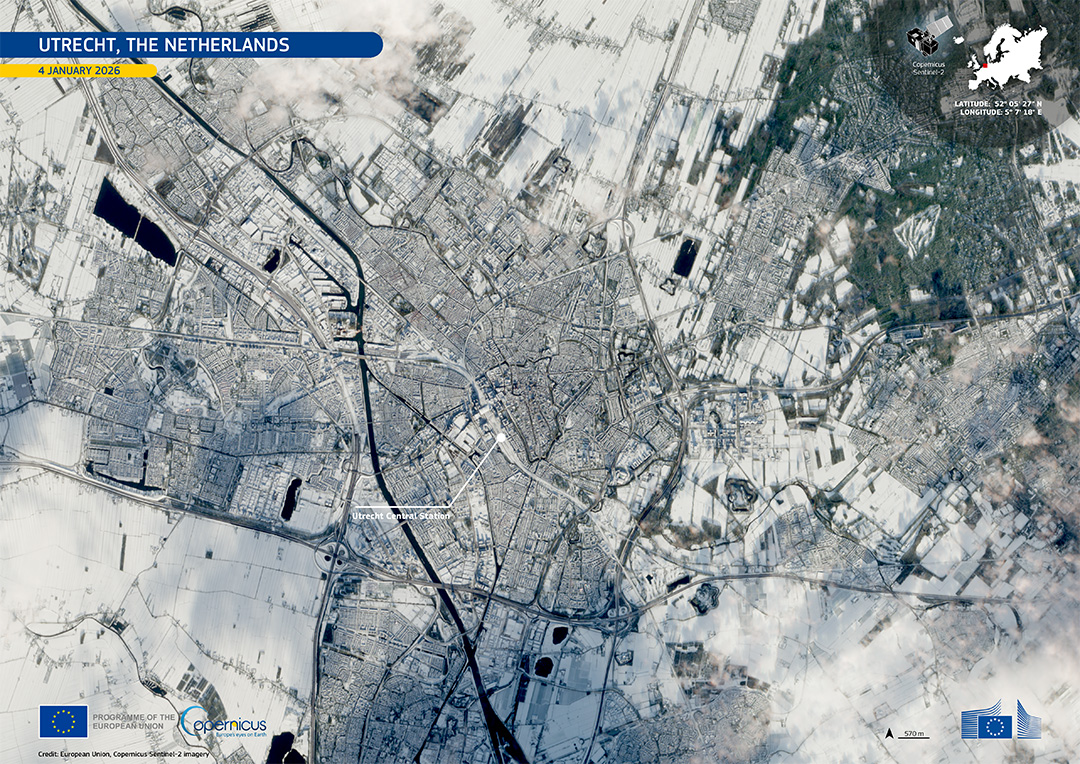
- - -On 4 January, the Sentinel-2 satellite captured the snowy image of Utrecht below. This shot of Amsterdam is lovely too.
“I’m not one for kicking up a fuss,” says writer Charlotte Mutsaers after twelve minutes in an interview with Nieuwsweekend in which she proves the opposite. You don’t see or hear that sort of contrarian conversation in the media very often anymore. Lovely!
You’ve just read blog post №148, written during the week of 5 to 11 January 2026. Subscribe to my newsletter and you’ll receive it free of charge in your inbox every Sunday.