
Nick Cave — Faith, Hope and Carnage
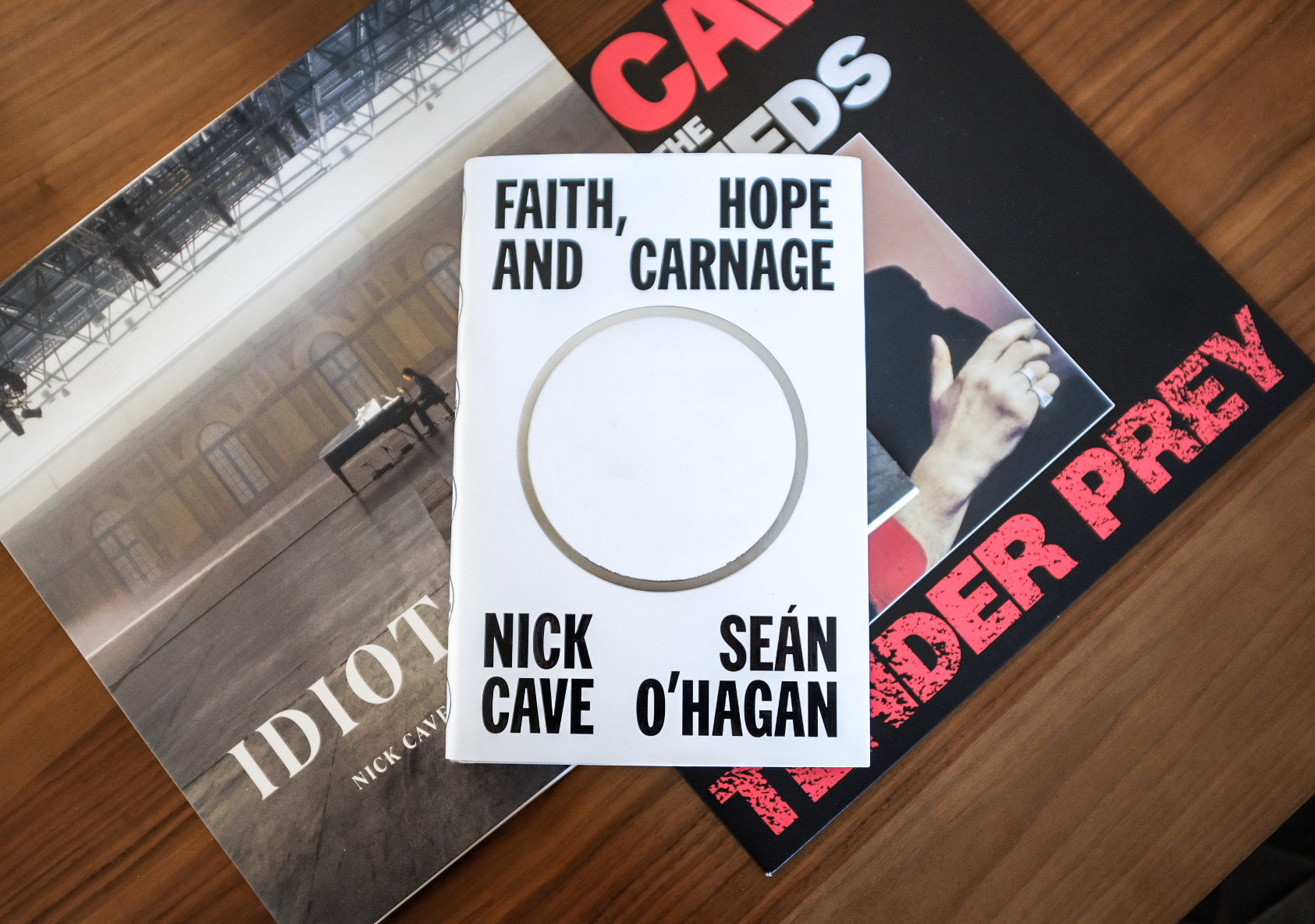
Those years are long past. The heroin was cast aside, but the religion remained. Journalist Seán O’Hagan saw that idea as the starting point for a book. The result is Faith, Hope and Carnage, a long interview with the singer reflecting on his life.
Cave has been going to church since he was a child. But it is only since the death of his son Arthur, who fell off a cliff in 2015 at the age of fifteen, that he has felt truly religious. “I’m not talking about traditional Christianity or belief in a god,” he says. “But in the sense that I suddenly felt, on a deep level, a profound connection to the human condition. I understood how vulnerable we all are.
But Cave also embraces faith on a more obvious level. The singer does not know whether God exists. But it is precisely in the existence of that doubt that he finds the space to surrender to it.
In doubt, faith finds its raison d’être
Just as in his newsletters, the Red Hand Files, Cave’s answers are thoughtful and weighty. The advantage for the reader is that O’Hagan has known Cave for thirty years. He dares to respond, give his opinion and press further. For instance, he does not shy away from pointing out that it is illogical for a god to allow people to doubt his existence.
“Since when has believing in God had anything to do with logic?” retorts Cave. That is precisely what makes it appealing to him. “My relationship with the world is broadened by fleeting glimpses of the divine. Why should I deny myself something positive simply because it isn’t logical? That in itself would be illogical.”
Cave collapses following Arthur’s death. In his own words, he shatters into a million pieces, and his memory is riddled with gaps from the period that followed. The album Skeleton Tree, which was largely written prior to his son’s death, feels in hindsight like a harbinger of the catastrophe. Cave can no longer listen to it.
In Ghosteen, the rather heavy album that followed, Cave found a form of mourning. He also describes this album as religious. “It’s about the human struggle and the need to rise above suffering. (…) Listening to it can purify the mind.”
Twitter as a factory of assholes
In Faith, Hope and Carnage, no time is wasted on small talk. O’Hagan and Cave delve deep, chapter after chapter. In doing so, Cave does not shy away from addressing the pandemic, for example. “We were given the chance to make the world a better place, and we squandered it.”
Things weren’t getting any better, he saw. The right was becoming more sinister, the left more extreme. Cave was on Twitter for a while (with a personal account), but gave that up after a year too. “Twitter is a factory that spits out arseholes. In the end, I got off all social media.”
A golden move. The world immediately became a better place, Cave recalls. “The quality of my life improved, the sun began to shine and the birds began to sing. My body no longer felt so tired, so exhausted and depressed because of everything. Social media makes you ill.”
From now on, Cave seeks happiness close to home. He talks at length about his new hobby: creating an eighteen-piece ceramic set that tells the story of the Devil.
Back to the light
Ah, physical decline affects us all, and ultimately Nick Cave too. Perhaps that is why he is seeking deeper meaning on a mental and spiritual level. If he is destined to live as long as his mother did, he still has thirty years to go. The loss of his son will stay with him; he would do well to embrace that. He knows it himself: “Grief can take people to dark places from which they never return”.
It is not that Cave is spared the struggle against darkness. “When I think of Arthur, I feel a heaviness in my heart. I think he regrets what happened to him and how much pain his death has caused us. That worries me greatly, because I think he carries this within his spiritual being. It sometimes overwhelms me enormously.”
So Cave does not take his remaining years lightly. Everything leads to one thing: forgiveness. A heavy word. “I ask for forgiveness to be freed from my own debts. (…) As a father, he (Arthur) was my responsibility and I looked away at the wrong moment.”