
116. Crying out for attention
I.
A month ago, I heard about Mei Social Vrij: an idea to stay off social media for the whole month of May. “To step back and discover what happens when you reclaim your attention,” wrote the organisers. I decided to take part in this experiment. I was curious to see what it would bring me.
I actually managed quite well without Instagram and Bluesky, but gradually I did fill the void left by these social media platforms with other apps. I watched more videos on YouTube and found myself on Reddit more often (a site I’d barely visited before May).
Substack, the service I use to send out this blog as a newsletter, also proved to be a pitfall. Recently, the platform has come to resemble a social media platform more and more. With a timeline for short posts, greater emphasis on followers and even space for live streams. Before you know it, you’re glued to such a service again, scrolling through feeds.
In a blog post on NU.nl, I describe what happened: I lived for a month without social media, yet I still spent a lot of time on my phone. Whereas I’d actually expected my screen time to drop significantly. On the phone, I told one of the organisers about my experiences and that bitter aftertaste, that I was a bit disappointed. Shouldn’t I have blocked YouTube, Substack and Reddit as well? People said the same in the comments on NUjij. As if I’d cheated, even though the initiative’s rules deliberately only named the usual suspects among the attention-grabbers, such as Facebook, Instagram and TikTok.
As well as the best-known platforms, there are many more apps vying for attention. They usually get less of a chance because they’re drowned out by the other apps. The initiator of Mei Social Vrij said that my experiences and conclusions were, in a way, to be expected. “These thoughts are actually leading somewhere now,” he said. “You can do something with this.” That’s true. Mei made me face the facts: apparently, I can’t keep my hands off my phone. So, although I’m simply reinstalling Instagram, I intend to cut back on my usage significantly. That will require some adjustments, starting with curating the accounts in my feeds more critically. And then we’ll see.
II.
The Marvel Cinematic Universe has been struggling to find its footing in recent years. After Avengers: Endgame, the most popular heroes and actors have moved on, leaving fans with mediocre films. But hang in there (says the die-hard Marvel fan in me), because there’s a glimmer of hope in the form of The Fantastic Four: First Steps, Avengers: Doomsday and Avengers: Secret Wars.
As far as I’m concerned, the upward trend has already begun with Thunderbolts, which I saw at the cinema this week. That asterisk does become clear in the film, by the way. This film is about a group of misfits with superpowers who, willy-nilly, have to work together to save New York. Nothing new so far.
The heroes in this film aren’t Marvel’s biggest stars. The studio knows that too. In fact, the studio has been aware of this for years. This theme has already cropped up in various films and series. Just look at Sam Wilson, the new Captain America, who constantly has to prove himself as Steve Rogers’ successor. People are creatures of habit, so the new hero is already 3-0 down from the start. In Thunderbolts, the sense of uncertainty is just as palpable. What happens if you don’t think you’re good enough? If you can’t accept yourself? And what if others don’t give you that chance?
One of the villains in this film, CIA Director Valentina Allegra de Fontaine (Julia Louis-Dreyfus is brilliant), has to protect her shady dealings. That’s why she wants to get rid of our heroes. After all, they’re just lonely misfits that nobody cares about, right?
You can probably guess how that ends. But this film doesn’t quite follow the script either, thanks to the mysterious character Bob. He is the linchpin of the film. Bob is a tragic figure, haunted by a past that has left him with considerable trauma. In doing so, Marvel makes room for themes such as mental health issues and the meaninglessness of existence. It’s not subtle – it remains a blockbuster and there’s plenty to laugh about – but it gives the film just enough weight to stand out from the recent Marvel crowd.
III.
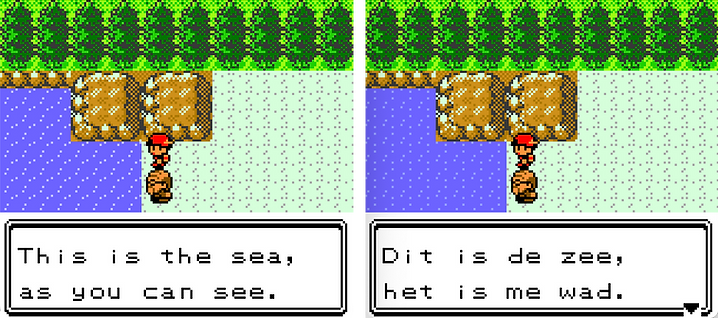
This is a heart-warming project. A friend of this blog, Bas Vroegop, wanted to introduce his young son to Pokémon, but the English language proved too much of a barrier. So he decided to translate the entire game Pokémon Crystal into Dutch himself. A few others stepped in to help him and voilà: after a year’s work, there is a translated version of the game.
Be sure to read Bas’s explanation if you want to know how much work goes into a translation like this; it’s really interesting and entertaining. Translation is a creative profession where you constantly come up against challenges. For example, how do you translate non-existent locations and names of trees that nobody in the Netherlands knows? What do you do with stereotypes that were normal 25 years ago, but might no longer be accepted today?
And I haven’t even mentioned the puns, which Bas has thankfully translated as well.
PS.
Loads of David Lynch’s personal belongings are being auctioned off. On the Julien’s Auctions website you can see, among other things, coffee machines, art books and film scripts going under the hammer. Scrolling through the website has a somewhat melancholic and intimate feel to it: an entire life passes before your eyes. These are all things Lynch collected during his lifetime. Ultimately, they are stripped of their sentimental, personal value and are simply items on a marketplace (which, incidentally, are being sold for far above their estimated value).
If you happen to have $400 stashed under your mattress: The Criterion Collection is releasing a box set of Wes Anderson films. It includes the first ten films he made over a period of twenty-five years.
- - -I still enjoy using the Arc browser. The fact that you can place tabs on the side of the screen instead of at the top was what won me over. But the creators of Arc, The Browser Company, do not consider the project a success. The company is therefore focusing on a new browser for the future: Dia. A browser in which AI takes the lead. With this, The Browser Company is heading down a path that will lose me as a user again, the pitch isn’t convincing either.
“Most people didn’t even notice that we’d stopped building new features,” writes the director. But most people don’t use browsers for new features. The point is that a browser enables you to navigate the internet in a way that suits you. New features require breaking an ingrained habit, which is why they often don’t catch on.
Matt Berninger’s (The National) new solo album is out. Get Sunk. I’ll be listening to that a lot in the coming weeks.
- - -Guillermo del Toro is adapting Mary Shelley’s classic horror novel Frankenstein for the screen. On paper, it’s a dream combination; the first teaser is now out.
- - -You’ve just read weekly blog №116, written between 26 May and 1 June 2025. Subscribe to my free newsletter to receive this blog in your inbox every Sunday.