
114. West Highland Way
> “Paths are the habits of a landscape. They are acts of consensual making. It’s hard to create a footpath on your own.” > > - Robert MacFarlane, The Old Ways
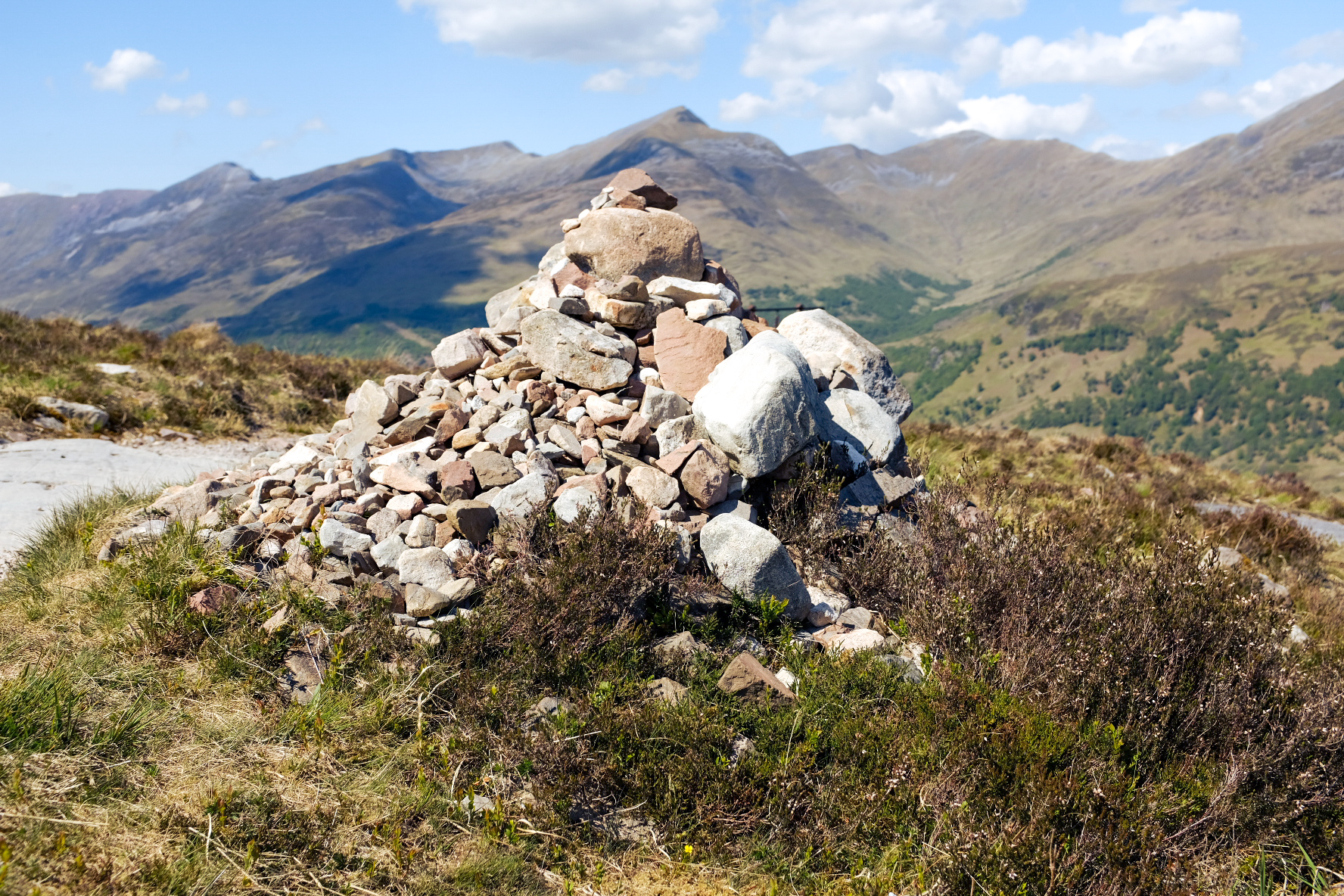
There are moments when we are the only people on earth. We look out over valleys and bare mountains. We look out over lakes and stretches of coniferous forest. And there is no one to be seen but us.
The West Highland Way is a unique walking route in Scotland. The path begins just north of Glasgow in the village of Milngavie, passes through a wide variety of landscapes and ends 154 kilometres further north in Fort William. My girlfriend and I, inexperienced walkers, join the route at the 85-kilometre mark, near the village of Tyndrum. From there, we walk four stages: Tyndrum ⭢ Bridge of Orchy (10.5 km) ⭢ Glen Coe (18 km) ⭢ Kinlochleven (17 km) ⭢ Fort William (24 km).
Before setting off, I had a romanticised view of this Scottish walking tour. We would walk all day long, bump into each other a few times, be cut off from the world, letting our thoughts run free. All of that without social media, so with a bit of luck we’d also get to be thoroughly bored in the old-fashioned way.
In Tyndrum, we settle down on a terrace in the sun (it’s warm! in Scotland!) and almost immediately we find ourselves in The Walkers’ Bubble. A woman, with whom I exchange two sentences in English before we discover we’re both from the Netherlands, asks if she can join us at the picnic table. She’s walking the entire West Highland Way from Milngavie to Fort William, solo, and has met lots of people along the way. Before we know it, a Texan joins us and we chat with others passing by, from Germany and the Netherlands.
We may only be joining halfway through, but the welcome from other walkers is warm. Many of them are walking the route with large rucksacks on their backs, sometimes laden with a tent and a sleeping bag. We send our luggage off every morning with a taxi company and sleep in relative luxury. Compared to the rest, we’re doing the ‘wimps’ version of this hike, but we have to start somewhere. We never feel like we’re falling short of the others, though. We are, however, inundated with tips and suggestions for future hikes before we’ve even properly started the West Highland Way. People love to share their passion. You can see them thinking: new walkers! Fresh blood! One of us!
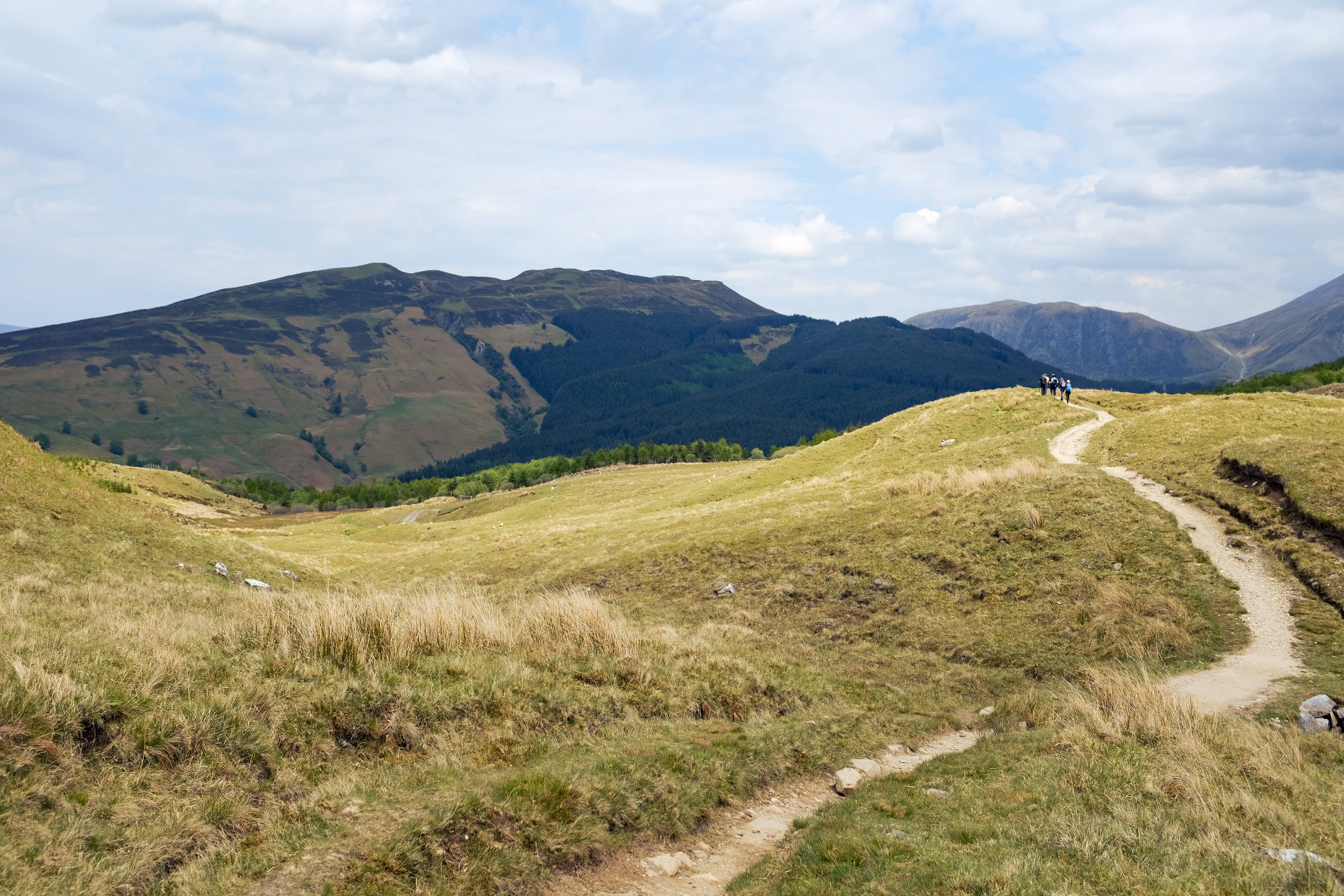
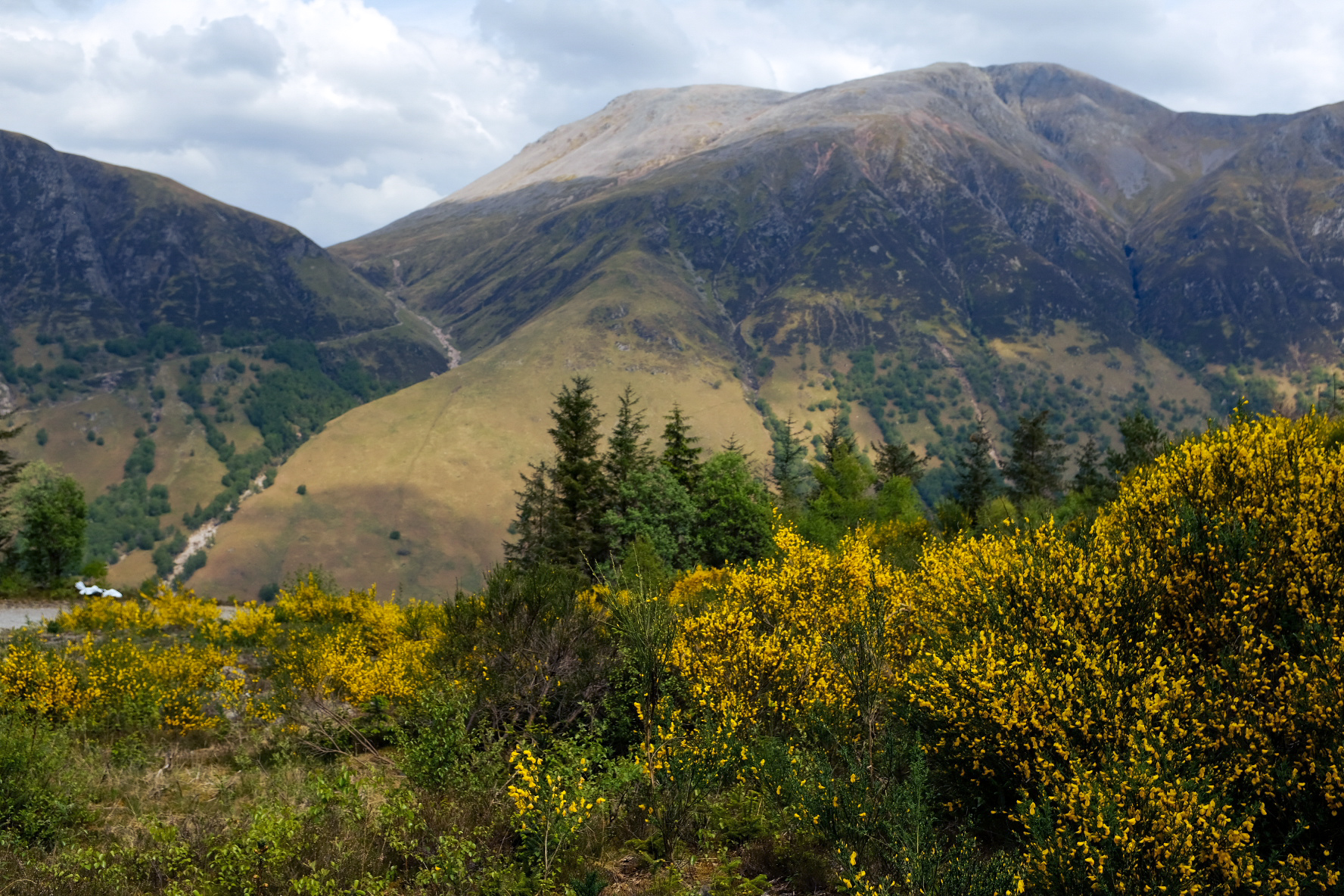
Right, we’re starting a day later with the shortest (and easiest) walk towards Bridge of Orchy. The paths are good and there’s hardly any change in elevation. In hindsight, this turns out to be the most boring route, but we’re already enjoying our first steps in the Scottish countryside. It’s warm, the ground is dry. The dreaded midges, swarms of biting flies that plague walkers in summer, aren’t here yet. There are a few sheep grazing, but they’re not causing any trouble. The mountains to our left and right are bare and brown. Along the paths, we are occasionally surprised by a sea of yellow flowers.
When we arrive at Bridge of Orchy after just a few hours, we strike up a conversation with a woman from North Carolina in the US, whom we saw taking photos of all sorts of flowers along the way. She is trying to capture as many different species as possible. Thanks to a booklet I have with me, she learns the name of those yellow flowers: gorse. She calls the bushes ‘the weed of Scotland’, because you see them everywhere. The plant is an invasive species that threatens to overgrow everything. But this ‘weed’ has its advantages. “It smells of coconut,” she says. And indeed, on subsequent walks we catch the sweet scent.
In any case, the people we meet are very observant of their surroundings. The woman from Rotterdam we met on the first evening, for example, studies birds and knows the history of the path. We also meet a couple from Texas who have been hiking all over the world for decades. We catch up with them almost every day, because they take things so easy and can happily spend an hour enjoying a view. The two become our role models during the trip. Spirit animals. Totem animals. Consciously slowing down, consciously enjoying. Combined with the others’ knowledge of birds and flowers, the walks take on a whole new dimension. I find my girlfriend smelling the flowers we come across along the way more and more often.
That night we sleep in an old station house in Bridge of Orchy, which now serves as a hostel. The landlady, Helen, calls herself ‘The Mad Woman’, and you can see that reflected in her little office and breakfast room. It’s a jumble of furniture, with papers strewn everywhere, and a collection of colourful teapots on the windowsill. Above a mantelpiece hangs a portrait of John Lennon. She herself bears a resemblance to actress Maggie Smith — the same eyes.
Helen has been running this place for 19 years. Initially with her husband, but since he passed away she has been doing it on her own. She lives next to the railway line in a caravan and welcomes different walkers here every day. As we are the last guests to leave that day, she chats away about this place and her life here. Before we set off on our 18-kilometre walk, she personally makes us a dry sandwich with bacon and then sends us on our way with a warm hug. She waves us off; the Mad Woman of Bridge of Orchy.
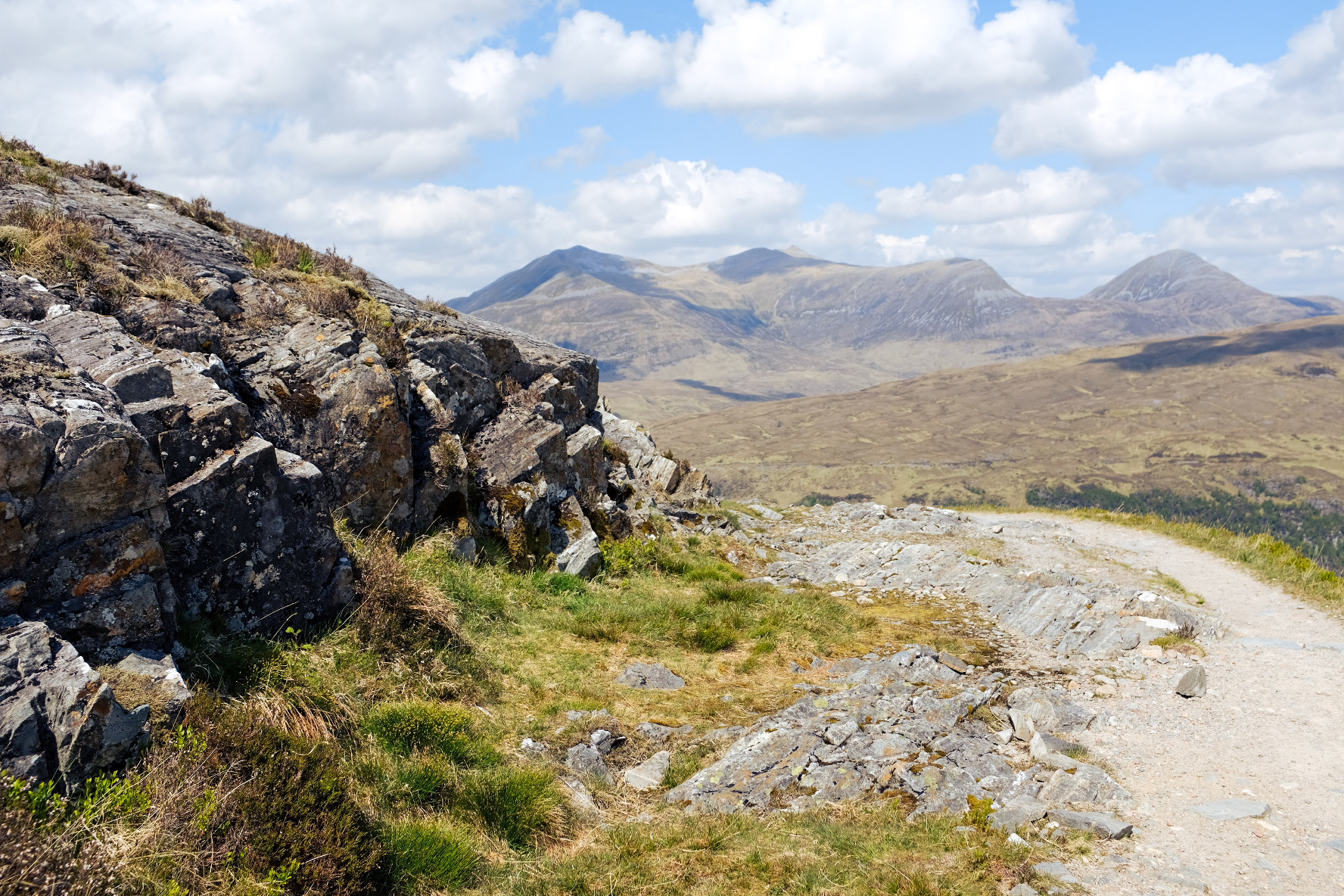
Today’s route takes us past places with names that could have come straight out of Star Wars or The Lord of the Rings. Inverornan, Loch Tulla, Black Mount, Rannoch Moor. We’re still walking through the mountains, like tiny people walking past stone giants, but today we see more greenery and water. The landscape becomes a bit rougher the further we go.
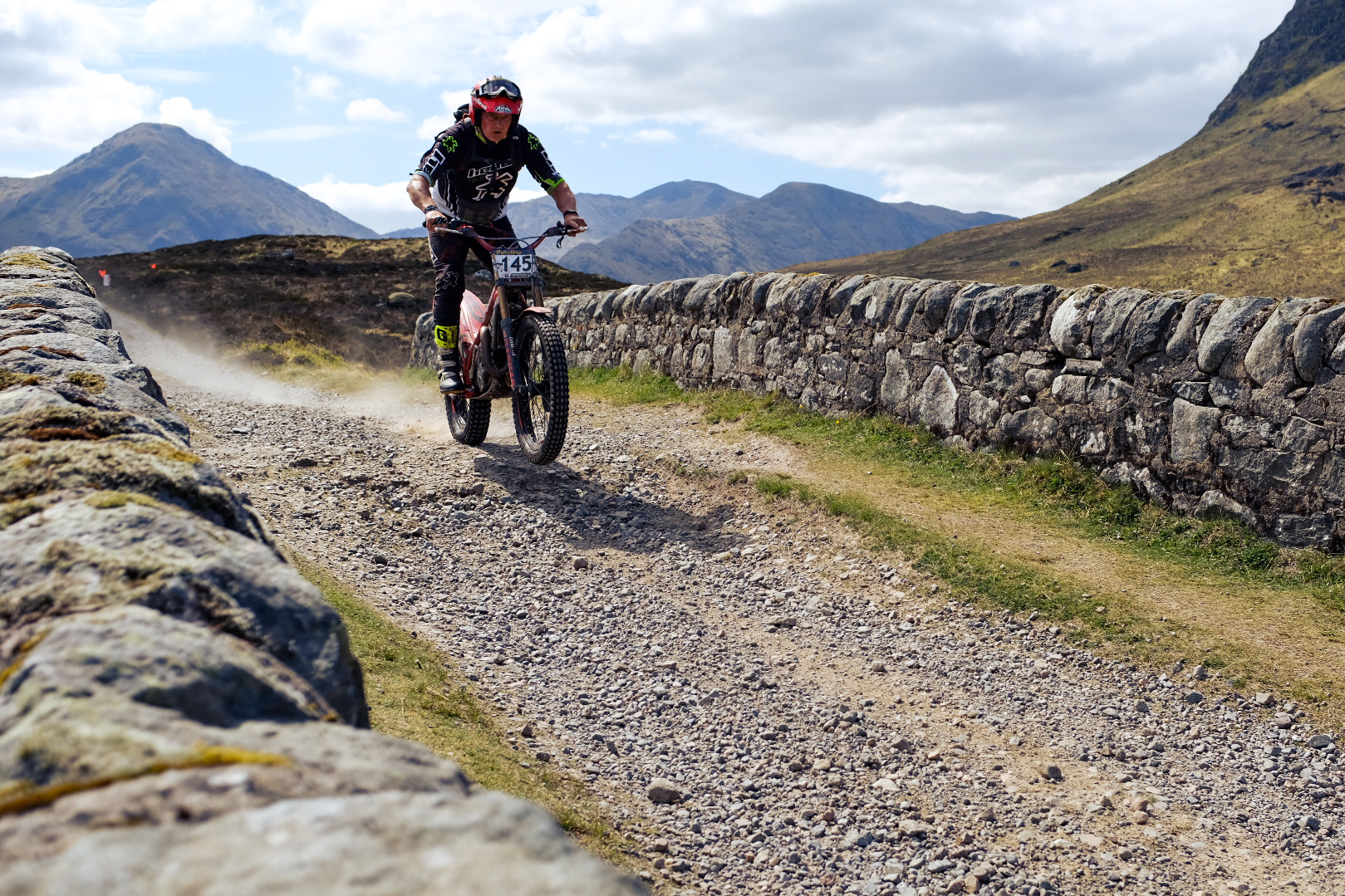
It is a beautiful walk, which is disrupted in the final few kilometres by a motorbike race. First we see the trial bikes descending in the distance, then it turns out that their route and ours overlap considerably. The roar and the clouds of dust are getting closer and closer. The leisurely walker would do well to wait on the verge for a moment as yet another rider races past.
It turns out this is an official race, part of The Scottish Six Days Trial. Every day, dozens of daredevils ride a 160-kilometre course. Online, I find videos of participants riding straight up a white-water river. Cool to watch, but it does make the last part of our day – which leads along an already tedious gravel track with loose boulders – a bit tougher.
On day 3, the route includes an obstacle known here in Scotland as the Devil’s Staircase. It could be a ceramic work by Nick Cave. In reality, it is a short 259-metre climb that reaches an altitude of 550 metres. The highest point of the West Highland Way is one of the most popular sections of the entire route. Day trippers also flock here.
At the foot of the climb stands a post with an image of a devil racing down the steps. The accompanying text tells us that the steep, winding path was built around 1750 by a group of soldiers, as part of the old military trail that we are largely following these days. It seems that a number of people have succumbed here over the years.
In the end, the climb isn’t too bad for us. Take it easy on the way up, and you’ll manage just fine. At the top, a few people are catching their breath. We bump into all sorts of familiar faces. The couple from Texas have been admiring the view for a while. The man is taking several photos. He walked the West Highland Way for the first time last October, without his wife at the time. He says he braved harsh conditions for much of the journey.
Because the route is so open, there’s nowhere to shelter from the wind and rain. The rain was lashing his face horizontally and the mountain peaks around him were shrouded in mist. The man is now marvelling at the view. On this sunny second attempt, the West Highland Way turns out to be a completely different world. The weather has been glorious for days. This means he can now enjoy the natural surroundings and the endless views — this time together with his wife.
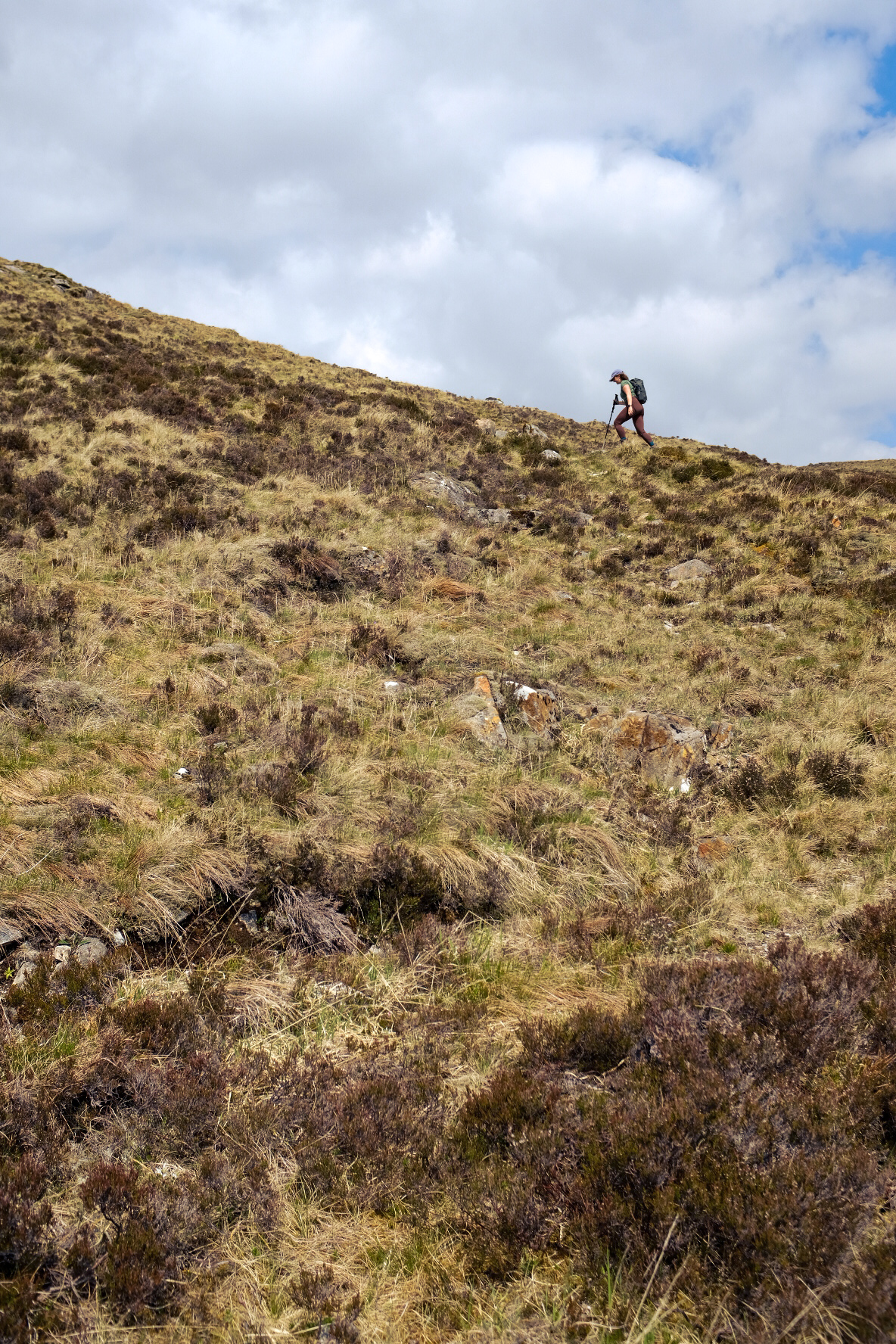
Our friend from Rotterdam has now found us too. After the Devil’s Staircase, she managed to tackle a neighbouring mountain peak as well. Well, well. We’re skipping that one for now. She’s now starting the descent that we’ll be tackling a little later. Because everyone’s following the same path, there’s always something to talk about. In the Netherlands, you can go for a lovely walk, but there are few people who undertake a long-distance trek and want to chat about it with you along the way. Here, there’s only one path, and if you’re not walking the West Highland Way, you’ve really got no business being there.
If you’re open to it, you quickly bond with other walkers. People hand out (Leuko) tape for blisters, grumble about motorbikes on the route, and you have a chat about life. Every conversation gives you an energy boost for the kilometres ahead.
Today, on the way to Kinlochleven, is one of the most beautiful routes we’ve walked. The descent after the Devil’s Staircase looks a bit wilder than anything we’ve seen so far. There are large rock slabs and winding mountain paths, after which a breathtaking view awaits us time and again. I take one photo after another, and none of them do justice to the feeling of freedom. “We’re grains of sand in a desert,” I joke to my girlfriend. “Drops in an ocean.”
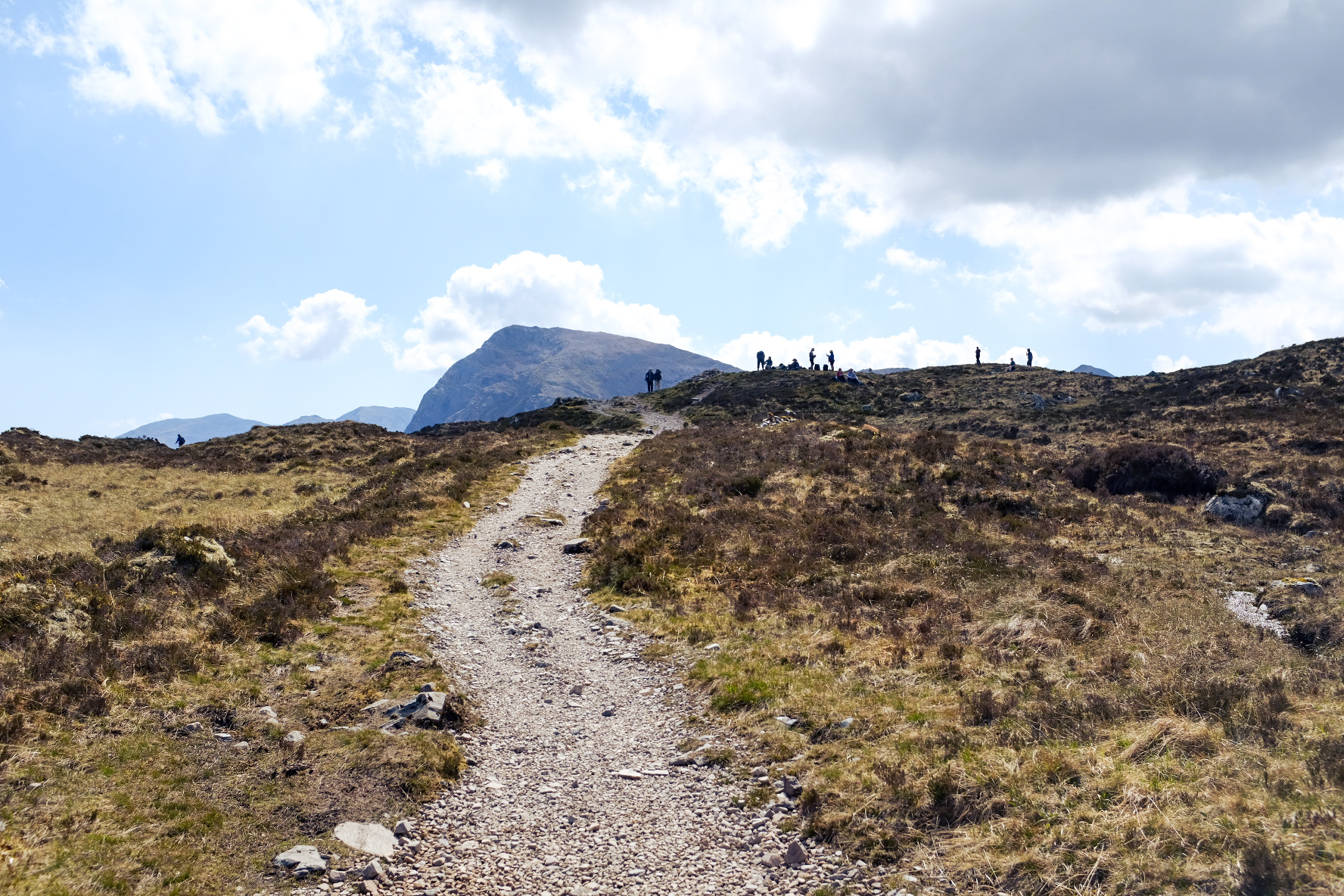
On the final day, we start with a steep climb through a forest. The path sometimes leads straight up. After every bend, I hope we’ve reached the top, but that isn’t the case four times in a row before it finally is on the fifth. The climb takes more effort than the Devil’s Staircase — and we still have 22 kilometres to go.
In the first half of this stage, more often than not we walk amongst other people through a vast open valley. Sometimes it’s nice to be able to see where you’re going, because you can follow the rucksacks and don’t have to think. This time, the winding path stretches so far towards the horizon that I can’t imagine that in a few hours’ time we’ll be the little dots we can now see moving in the distance. It takes a bit of mental effort, but with every step we get closer to the finish line in Fort William.
This final day is greener than the previous days. We walk through a forest and bump into four men from Limburg whom we’ve seen before. “We were just wondering how you were getting on,” says one of them. I suddenly realise that we, too, are part of the stories other people experience during their walk through the Highlands.
They seem a bit out of place, these men from Limburg, only one of whom actually still lives in Limburg. With the rest, you only hear about it. “Normally we go away for a weekend to get drunk, but we’re all getting a bit older, have children and wanted to try something different,” says the leader of the group. One of them is now swapping his hiking boots for trainers. It seems to me a bad decision on these seemingly endless gravel paths. He’ll feel every stone. But it has to be said: when we walk with them for a bit afterwards, we cover ground at a brisk pace.
When we reach the edge of the forest and have another short, steep climb behind us, we say goodbye to the group. We take a break with a view offering a different slice of nature in every direction. This is where it all comes together.
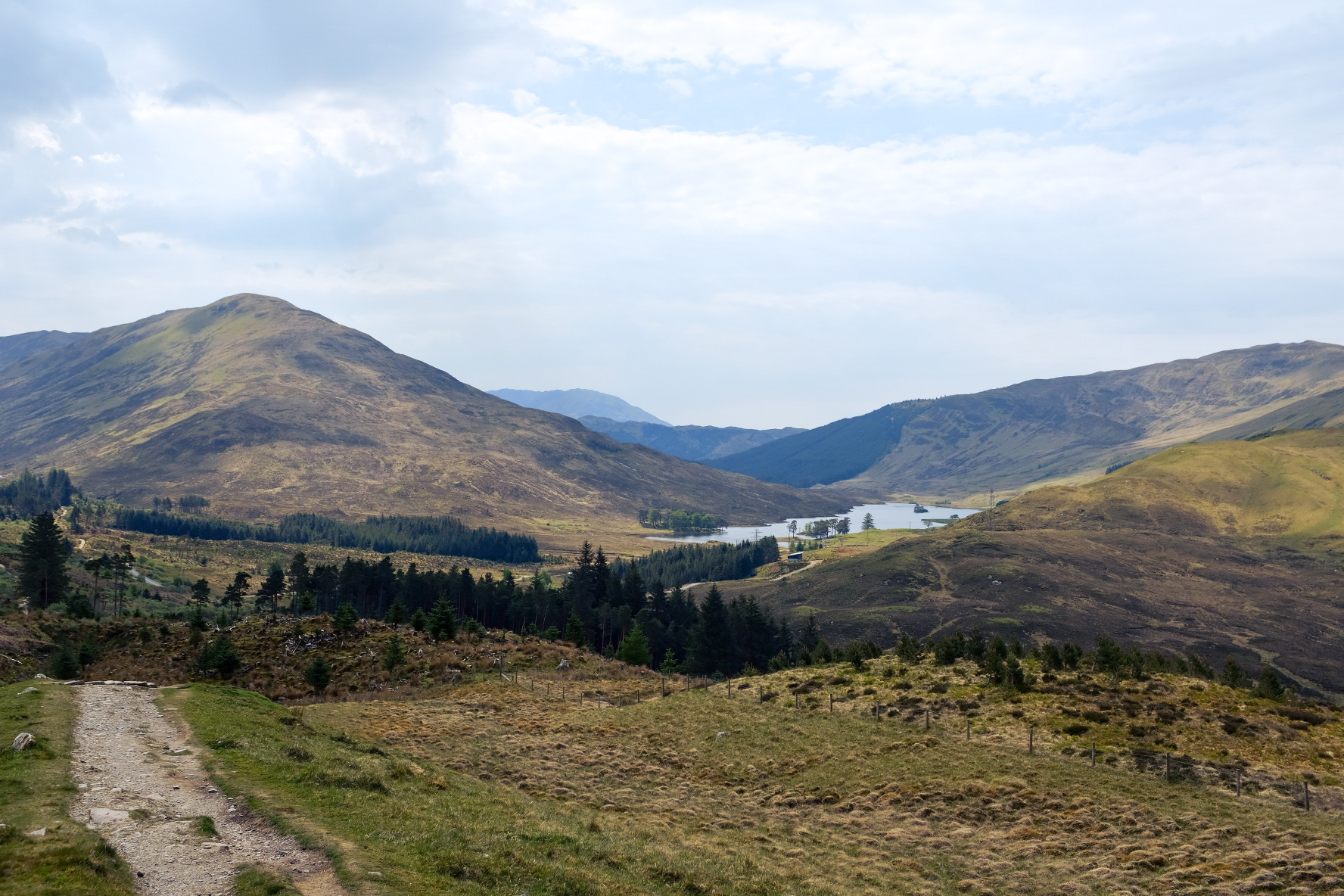
“Are we forgetting to enjoy ourselves?” we sometimes ask each other out loud. It’s a question that sounds cynical but isn’t meant that way. We are admittedly a bit tired and can feel our feet, but we’re walking through stunning surroundings that you risk taking for granted after a few days. We think of the Texan couple who are quietly taking it all in, the woman from Rotterdam with her knowledge of birds, and the woman from North Carolina with her eye for flowers.
When we reach the finish line after 24 kilometres and pop into a pub, it turns out that almost everyone we met along the way is there. We discuss the final day, exchange congratulations, and a Scottish man shares some expensive whisky he’s bought as a reward for himself. All the clichés ring true here: it’s all about the journey and the friends you make along the way. After tonight, we’ll never see each other again, but when we look back on the West Highland Way in the future, we’ll think just as much of the people we met as of the walk and the unrivalled scenery itself.
You have just read weekly blog No. 114. A travelogue written between 12 and 18 May 2025. Subscribe to my free newsletter to receive this blog in your inbox every Sunday.