
156. Soon everything will have changed
I.
Wim Wenders and Tokyo is a great combination. We saw that in his film Perfect Days. In the 1980s Wenders also traveled to Japan. As a fan of the films of Yasujirō Ozu, he went searching for the traces and images the director had left behind. Wenders made the documentary Tokyo-Ga: half travel diary, half love letter to Ozu. A beautiful film.
After watching Tokyo-Ga (I had put it on out of nostalgia for the city) I finally decided to watch something by Ozu. I chose Tokyo Story, about an elderly couple who travel to Tokyo to visit their children. Once there, the children turn out to have barely enough time to fit their parents’ visit into their busy lives.
The film takes its time portraying the family. Ozu is in no hurry to tell his story. As a result, Tokyo Story can sometimes seem to drift along, but in the background all sorts of themes are at play. Regret, finitude, the importance of family and appreciating the small things in life (you immediately understand where Wenders got his inspiration for Perfect Days). Ozu lays his message on rather thick, it should be said. Even so, it grabbed me by the throat.
In Tokyo-Ga, Wenders speaks with Ozu’s regular cinematographer. A wonderful interview; the love radiates from it. Ozu always filmed with a 50mm lens, which brought him literally and figuratively close to his characters. In Tokyo Story I saw how Ozu doesn’t seek the wide view but instead creates depth within his frames. You look through many windows and doorways, drawing the eye into the image like a peephole box.
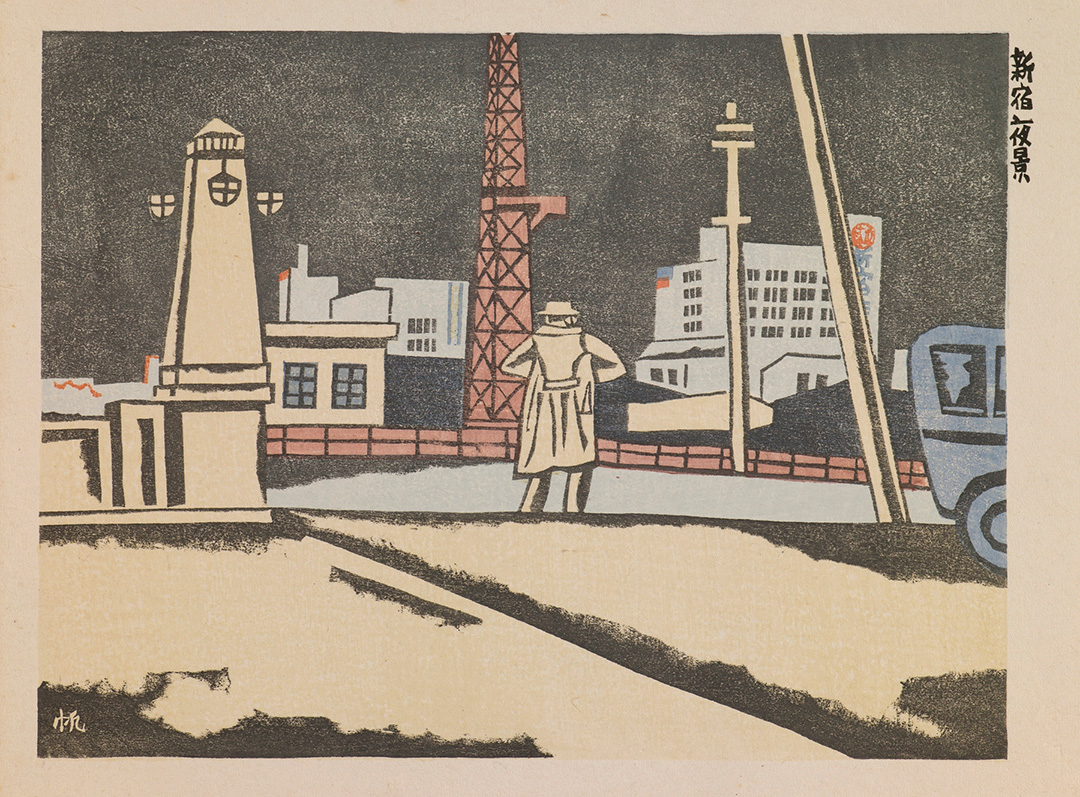
Wenders visits Ozu’s former colleagues and sees how Tokyo has changed in the decades since Ozu’s death. American culture has put down roots on Japanese soil, to name one thing. We see leather jackets, quiffs, rock ‘n’ roll, baseball.
Werner Herzog briefly enters the picture. In an inimitable rant he sighs that in the endlessly built-up city of Tokyo¹ you have to search very hard for images that reflect our inner nature. Tokyo changes, and so do its inhabitants. You can see that in the pachinko parlors where people spend hours.
“This game first appeared after the last war,” Wenders says. “When the Japanese people had a national trauma to process. This game works like a kind of hypnosis. A strange sense of happiness. Winning isn’t so important, but time passes. You lose contact with yourself for a while and merge with the machine.”²
Yet Wenders doesn’t entirely agree with his friend Herzog. The images he is looking for can only be found precisely within the chaos of the city. “Despite everything, I couldn’t help but be impressed by Tokyo,” he says. The transience of everything³ is exactly what speaks to him. That is why he documents the city — because soon everything will have changed.
II.
Harold Halibut is a remarkable game that looks like a stop-motion puppet film. It is about a group of people on board the spaceship FEDORA I, which fled Earth when war was threatening. In their search for a new habitable planet, the ship’s inhabitants have ended up (and sunk) on a water world. They have been surviving underwater for generations.
You play as Harold, assistant to FEDORA I’s chief scientist. Together with her you search for a way to escape the sunken ship and continue the search for a new home. You experience that story through endless conversations with all kinds of colorful figures on board. As a player you walk around a lot (the same stretches) and frequently watch dialogue. There is a very great deal of dialogue.
In that sense, Harold Halibut is secretly more of an interactive film. And what appeals to me most about it is the style of the dry-comedic, retrofuturistic story. That style feels like a cross between Anomalisa and the stop-motion films of Wes Anderson. The characters look as if they came out of a 3D printer — you can see the brushstrokes and cracks on their faces. The environments are handmade dioramas. Kudos for the execution.
The game picks its moments to convey a sense of wonder or mystery. At one point you are in a kind of submarine, sailing through a cave system with neon-colored plants. A funky guitar begins to play and a German voice rings out: “Es wird warten auf den Mann / Es wird fragen, wann, endlich wann / Wird er da sein?”
The song is Im 80. Stockwerk and was recorded more than fifty years ago by German actress and singer Hildegard Knef. I had no idea. I look up her biography online. She was for a time seen as the new Marlene Dietrich and appeared in American films, until her wartime past surfaced and Hollywood stopped calling. As a teenager Knef had appeared in Nazi propaganda films. That eventually landed her in a Russian labor camp, from which she managed to escape.
She decided to start singing in the 1960s and recorded the album Knef in 1970. I have to say, I’ve given it quite a few spins this week, after finishing Harold Halibut.
PS.
Here is a Geese tour diary in video form. A home-video kind of thing. It reminds me of the video diaries by Christopher Owens (Girls) from years ago. The best moment in this Geese video is how Cameron Winter describes the fans he met earlier in the day.
This excellent article from Aftermath makes crystal clear how games journalism is slowly being destroyed as domain names are bought up and stuffed with casino and AI garbage. In the Netherlands, among others, PU and Playsense fell victim to this.
The benefit album HELP(2) is out. On the initiative of War Child, some of the biggest artists of the moment recorded songs to raise money for charity. You’ll hear, among others, Fontaines D.C., Cameron Winter, Arctic Monkeys, Bat For Lashes, The Last Dinner Party, and Olivia Rodrigo. A great compilation! At the Volkskrant you can read more about the history of the HELP initiative.
Dutch ditches are disappearing, according to Volkskrant research. Farmers are filling in the ditches (often illegally), with all the consequences that entails. “In the filling-in, a large number of animals were buried alive,” says an ecologist in the piece, “such as weatherfish and pool frogs.”
An excellent cover of I Wanna Be Adored by Turnstile.
You read blog №156, written in the week of 2 to 8 March 2026. Subscribe to my newsletter and you’ll receive it every Sunday free in your mailbox.